
Compiled from public reports
Multidisciplinary collaboration at the General Surgery Center | Gastrointestinal Surgery successfully performs simultaneous curative resection for rectal cancer with liver metastasis
Liver metastasis was found at diagnosis. After preoperative treatment and reassessment, the gastrointestinal and hepatobiliary surgical teams treated both sites in the same operation.
Compiled by SinoCareHub · Information checked: 2026-11-13
Patient overview
67-year-old woman · China · Beijing · Preoperative chemotherapy with immunotherapy, rectal cancer resection and partial liver resection
- Treatment in China:
- Preoperative chemotherapy with immunotherapy, rectal cancer resection and partial liver resection
- Outcome at the reported stage:
- Both the rectal and liver specimens had tumour-free margins. The patient had no serious complications during her hospital stay and was discharged.
Hospital report
Han Jiagang’s Gastrointestinal Surgery team at Beijing Chao-Yang Hospital’s General Surgery Center joined forces with Fan Hua’s Hepatobiliary, Pancreatic and Splenic Surgery team to treat a 67-year-old woman with rectal cancer and synchronous liver metastasis. After she completed neoadjuvant chemotherapy combined with immunotherapy, the teams successfully performed laparoscopic radical resection of the rectal cancer together with partial liver resection. The patient recovered well after surgery and has been discharged.
Six months earlier, the patient sought care for a change in bowel habits. Colonoscopy revealed a rectal lesion, and pathology confirmed a malignant rectal tumor. Rectal magnetic resonance imaging (MRI), PET/CT and contrast-enhanced upper abdominal MRI, among other examinations, led to a diagnosis of adenocarcinoma of the middle to upper rectum with metastasis in segment 7 (S7) of the liver. She also had grade 2 high-risk hypertension and hyperlipidemia. Colorectal cancer with synchronous liver metastasis is a serious and clinically challenging condition. Its diagnosis and treatment are complex, and it is difficult for a single specialty to balance curative treatment with the patient’s postoperative quality of life.
To develop the best treatment plan, the General Surgery Center promptly convened a multidisciplinary consultation led by Gastrointestinal Surgery, with participation from Hepatobiliary, Pancreatic and Splenic Surgery, the Oncology Center and the Medical Imaging Center, among others. Based on the cancer stage, the patient’s physical condition and her underlying illnesses, the specialists agreed on an individualized plan. They would first give four cycles of chemotherapy combined with immunotherapy to downstage and shrink the tumors. They would then remove the primary rectal tumor and the liver metastasis in one operation, with the aim of achieving curative resection while avoiding repeated operations and reducing surgical trauma and the burden of treatment.
The patient tolerated four cycles of standard neoadjuvant treatment well, and the tumors regressed markedly. Follow-up imaging showed substantial shrinkage of the primary rectal lesion, the involved lymph nodes and the liver metastasis. The multidisciplinary team reassessed the patient and found her eligible for surgery with curative intent.
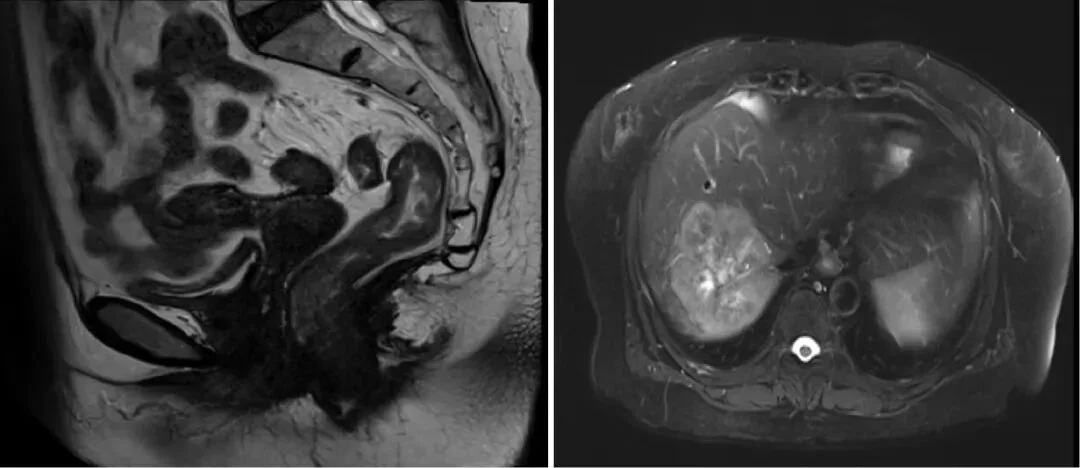
The operation was technically demanding and carried significant risk. It required the teams to treat both the rectal tumor in the pelvis and the liver metastasis in the upper abdomen in the same operation, across a wide surgical field with complex anatomy. After neoadjuvant treatment, the local tissue planes were poorly defined and the liver tissue was fragile. The metastasis was also close to the inferior vena cava, making bleeding control difficult. The patient’s multiple underlying conditions further increased the risk of perioperative complications.
To ensure surgical safety and achieve curative resection, the teams carried out a comprehensive preoperative assessment with the Anesthesia and Operating Center and the Department of Critical Care Medicine. They repeatedly rehearsed the operative plan, defined the extent of resection and refined their contingency plans. They prepared for unexpected intraoperative events and drew up a detailed plan for simultaneous resection.
The operation proceeded smoothly under general anesthesia. Following the principles of total mesorectal excision (TME), Han Jiagang’s team carefully mobilized the lesion, dissected the lymph nodes and reconstructed the digestive tract, completely removing the primary rectal tumor. Fan Hua’s team then exposed the operative anatomy and resected the liver metastasis. During laparoscopic exploration and mobilization of the liver, the team found that repeated chemotherapy had left the liver tissue fragile and prone to bleeding. The metastasis was closely associated with the junction of the right hepatic vein and the inferior vena cava. To maintain safety and achieve an adequate resection, the team converted to open surgery. Under direct vision, the surgeons divided the liver tissue along the main trunk of the right hepatic vein to extend the resection precisely. They confirmed negative margins and removed the metastasis completely. The operation took more than seven hours and achieved curative resection of both lesions (R0 resection). Postoperative pathology found no residual tumor at either the rectal or liver resection margins, meeting the pathological criteria for curative resection.
After surgery, the care team followed enhanced recovery after surgery (ERAS) principles, tailoring perioperative management to the patient, starting enteral nutrition early and guiding her through a gradual return to activity out of bed. With close treatment and nursing care, she developed no serious complications. Her drain was removed, and she recovered and was discharged as planned.
Subspecialty development and multidisciplinary integration
The success of this operation resulted from close collaboration among the subspecialties of Beijing Chao-Yang Hospital’s General Surgery Center. In recent years, the center has continued to develop its subspecialties and integrate multidisciplinary care. It has established routine MDT pathways for complex conditions such as colorectal cancer with liver metastasis and advanced gastrointestinal tumors. For metastatic gastrointestinal tumors, the center can provide disease assessment, systemic treatment, surgery with curative intent and postoperative management throughout recovery in one place. By operating together, teams from different specialties can perform simultaneous curative resection of tumors in multiple organs, reducing surgical trauma and shortening the course of diagnosis and treatment in keeping with a patient-centered approach.
Sources and scope
- [1] Rectal cancer with liver metastasis at diagnosis: one patient’s treatment
Beijing Chao-Yang Hospital ·
Image source: Beijing Chao-Yang Hospital · Selected scan images from the hospital report
Plan care in China
Ask about medical records and contacting hospitals.
Related doctors and hospitals

More patient stories
- Looking ahead to 100 with expert care | Beijing Chao-Yang Hospital successfully performs complex minimally invasive colorectal cancer surgery on a 96-year-old retired employee
- Esophageal cancer and severe coronary disease: how a team planned two operations
- Treating septic shock after uterine perforation in a patient with cervical cancer