
Compiled from public reports
‘Grow taller, then come back!’ — My six-year journey from ending a pregnancy to welcoming a new life
A patient’s letter published by Peking University First Hospital recounts spinal correction, another pregnancy and multidisciplinary care through childbirth.
Compiled by SinoCareHub · Information checked: 2026-11-20
Patient overview
A mother who wrote to the hospital · China · Beijing · Spinal correction and multidisciplinary high-risk pregnancy care
- Treatment in China:
- Halo-pelvic traction followed by spinal correction by Yu Wang’s team; obstetric and multidisciplinary care during a subsequent pregnancy.
- Outcome at the reported stage:
- The letter reports an increase in height from 138 cm to 152 cm, some improvement in lung function, and discharge of both mother and baby after a subsequent delivery.
The patient’s letter
I am a mother who went through many difficulties but ultimately welcomed a new life under the care of Peking University First Hospital. With profound gratitude and respect, I would like to express my sincerest thanks to obstetrician Chen Qian and the multidisciplinary team.
I. A promise that brought warmth to the darkest moment
My first encounter with Peking University First Hospital was in 2019. I was only 1.38 metres tall and had severe scoliosis with respiratory failure. Although I was already pregnant, a multidisciplinary assessment concluded that, to protect my life, I should not continue the pregnancy. The decision to end it was heartbreaking. Before the procedure, in the ward, obstetrician Chen Qian seemed to understand my deep reluctance, gave me a warm embrace that I have never forgotten, and said, ‘Grow taller, then come back!’
Dr Chen was not only a meticulous doctor; her empathy helped support me emotionally. The procedure went smoothly. On the way to the intensive care unit (ICU), while still only partly conscious, I made a gesture of thanks to the medical staff. Being in the ICU gave me my first vivid appreciation of how precious life is. The staff cared for me attentively. Dr Chen and Que Chengli from Respiratory and Critical Care Medicine, whom I had met through the multidisciplinary consultation, visited me personally. They also told me, ‘Scoliosis need not be feared; you can see Yu Wang in Orthopaedics for spinal correction.’ This brought a ray of hope into my despair and helped me understand Dr Chen’s promise.
II. Spinal correction rekindled the possibility of another pregnancy
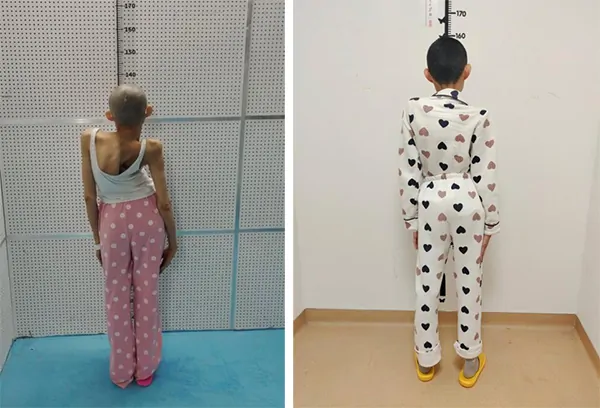
Two years later, in October 2021, I began the journey towards spinal correction. Before surgery, I needed halo-pelvic traction, so I shaved my head. After six holes were made in my skull and the frame secured with screws, I wore what I called my ‘tightening headband’. I felt like a ‘robot’: I could sleep only on my back, could not turn over, and endured pain from the traction on my nerves, especially at night. After nearly five months in hospital undergoing traction, I finally reached surgery in February 2022. Yu Wang’s orthopaedic team successfully performed my spinal correction. Those months of pain and perseverance brought a new beginning: my height increased from 138 cm to 152 cm. My abdominal space improved substantially, my curved spine became noticeably straighter, and my lung function improved to some extent. The experience allowed me to stand straighter and created possibilities for a future pregnancy.
III. Welcoming a new life, with multidisciplinary support through a ‘miracle pregnancy’
In September 2024, when I became pregnant again, joy came with apprehension. I returned to Obstetrics to see the familiar Dr Chen Qian. She was delighted by the news and understood how much this pregnancy meant to me. She guided me throughout, from routine antenatal checks to amniocentesis, until I reached the third trimester.
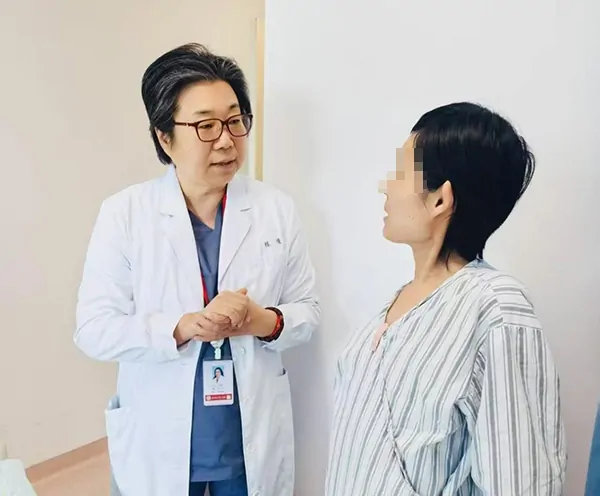
At this crucial stage, the growing baby increasingly affected my already limited breathing function. After repeated assessments, Que Chengli recommended a sleep breathing study to observe my breathing at night. When the results were available, Ma Jing, head of Respiratory and Critical Care Medicine, recommended non-invasive ventilation at night. As I was in hospital, Dr Ma immediately arranged for me to borrow a hospital ventilator. Dr Chen later told me it was provided free of charge, saying, ‘This is part of the medical ethics of Peking University First Hospital.’ At 31 weeks, following consultation, I spent a night in the respiratory monitoring unit to assess how nocturnal non-invasive ventilation affected my carbon dioxide partial pressure at that stage of pregnancy. Yu Kunyao was very patient, and the whole team took great care of me as a high-risk pregnant patient.
At 33 weeks, after another consultation, I was admitted in preparation for delivery. Dr Chen brought together Respiratory and Critical Care Medicine, Cardiology, Anaesthesiology, Neonatology and Intensive Care for a multidisciplinary consultation, and the caesarean section was scheduled for 34 weeks. The hospital-wide team’s careful preparation left me feeling safe rather than afraid on the operating table. It reflected something Dr Chen had said: ‘We never go into a battle unprepared.’ After close postnatal monitoring and management, I was discharged first. Following treatment by the neonatal intensive care unit (NICU), my baby was also discharged, bringing this difficult pregnancy journey to a happy conclusion.
IV. Medical compassion lit the way forward
Throughout this long journey, I witnessed the hospital’s commitment to putting patients first: the ventilator provided free of charge by Respiratory Medicine, the attentive respiratory monitoring, and the neonatal team’s care for my baby. These acts made me feel that Peking University First Hospital was not only a place that treated disease, but also a haven where humane care comforted the heart.
As I write, tears blur my eyes again. Over these six years, from despair to hope and from loss to a new beginning, your skill and compassion repeatedly lit the way for me. As a mother, please allow me to express my deepest respect and gratitude to the following staff:
Chen Qian, 卡力毕努尔·克来木, Meng Xiangrui, Zhou Rui, Dou Ruochong, Zhang Congyue and all the staff of Obstetric Ward 2 at the Obstetrics, Gynaecology and Reproductive Medicine Center; Yu Wang in Orthopaedics; Que Chengli, Ma Jing, Yu Kunyao and all the respiratory monitoring unit staff in Respiratory and Critical Care Medicine; Ma Wei in Cardiology; and Sang Tian, Geng Yuehang, Li Li, Liu Panpan, Zhang Qiannan and the other NICU staff.
To those who helped during my pregnancy whose names I do not know, and those whose quiet work I have not mentioned, I bow in thanks. Through your skill and kindness, you wove a safety net that supported the dream of this high-risk mother. One day I will tell my child how much care and how many blessings from the medical staff accompanied his arrival.
Afterword from the Obstetrics, Gynaecology and Reproductive Medicine Center team
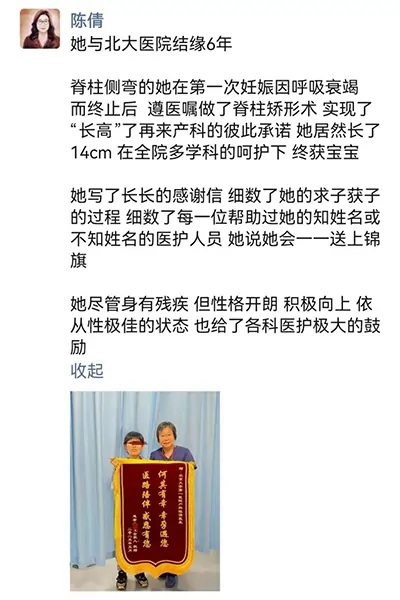
Chief physician Chen Qian’s WeChat Moments post
Her cheerful character and positive approach to life deeply moved us. Her successful experience brought us great comfort and encouragement. Her becoming a mother as she had hoped reflects the combined strength of Peking University First Hospital’s multidisciplinary teams and the hospital’s commitment to maternity-friendly care.
Sources and scope
- [1] “长高了,再回来!”——从被迫终止妊娠到成功拥抱新生,这条路,我走了六年......
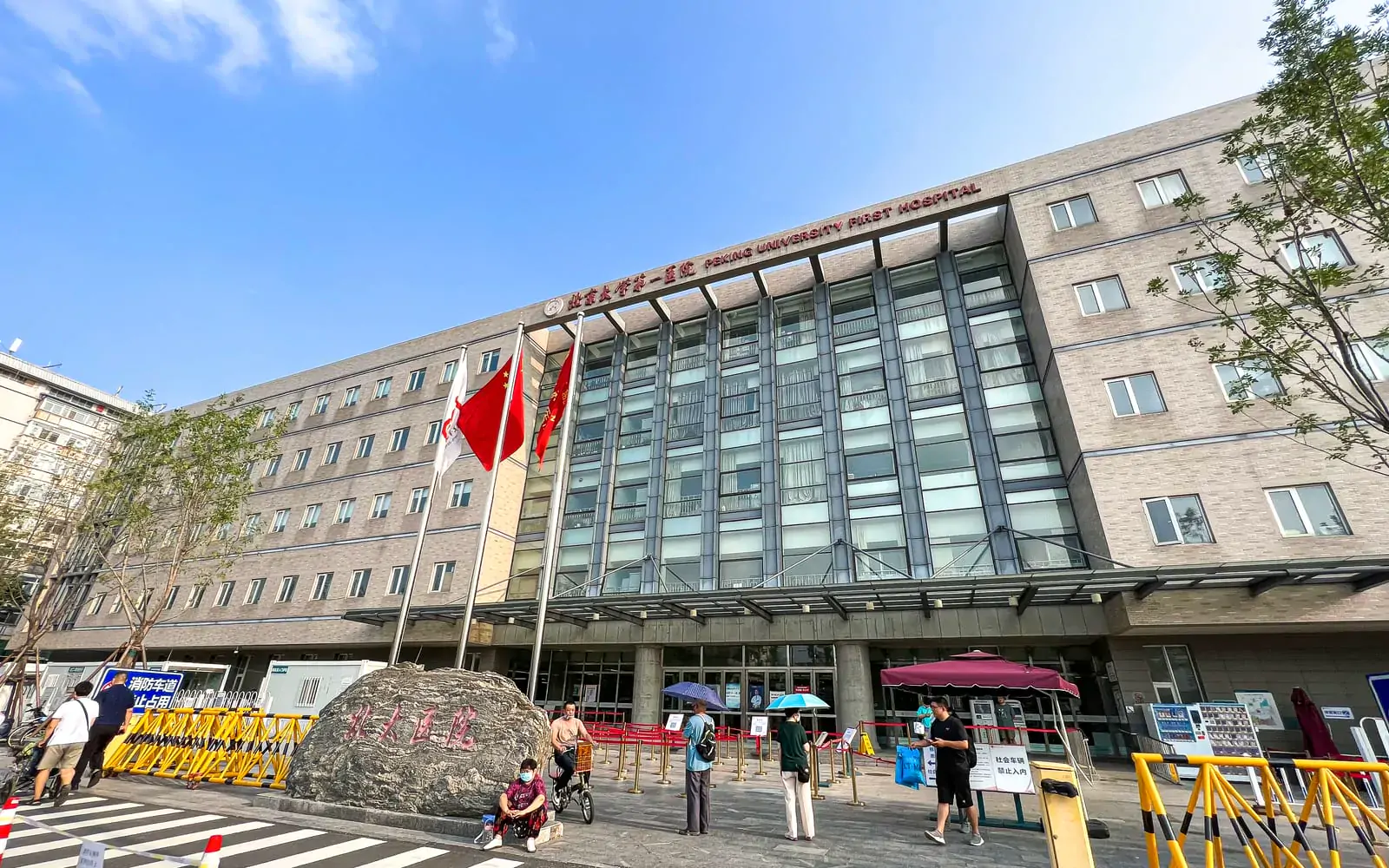
Peking University First Hospital ·
Image source: Peking University First Hospital · Before-and-after comparison
Plan care in China
Ask about medical records and contacting hospitals.
Related doctors and hospitals
More patient stories
- Beijing Friendship Hospital successfully performs two day-case thoracoscopic lung resections
- Looking ahead to 100 with expert care | Beijing Chao-Yang Hospital successfully performs complex minimally invasive colorectal cancer surgery on a 96-year-old retired employee
- Multidisciplinary collaboration at the General Surgery Center | Gastrointestinal Surgery successfully performs simultaneous curative resection for rectal cancer with liver metastasis