
A wireless brain-computer interface implant four years after cervical spinal cord injury: one published case from Beijing Chaoyang Hospital
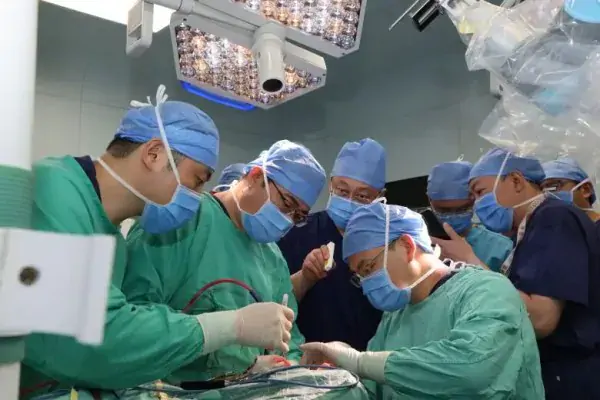
On 13 August 2026, a neurosurgery team led by Liu Changqing at Beijing Chaoyang Hospital, Capital Medical University, implanted a wireless brain-computer interface in a 52-year-old man with quadriplegia after a traffic injury to the cervical spinal cord. The hospital described it as the hospital's first case after the trial opened. This account follows the hospital news of 17 August 2026. SinoCareHub did not arrange this patient's care, and the report does not predict another person's result.
Compiled by SinoCareHub · Information checked: 2026-11-05
Patient overview
A 52-year-old man · China · Beijing · Implantable wireless brain-computer interface · cervical spinal cord injury
- Treatment in China:
- Changying Campus, Beijing Chaoyang Hospital, Capital Medical University · wireless brain-computer interface implanted on 13 August 2026. The hospital news says the operating team was led by Liu Changqing, deputy director of neurosurgery, with Jia Wang of Beijing Tiantan Hospital present for technical guidance.
- Outcome at the reported stage:
- The hospital reported that the flexible electrodes and fully implantable signal collector were placed that day, and that vital signs stayed stable during surgery. The same report says signal-adaptation training and longer follow-up were still ahead. It does not give a follow-up result showing that this patient could already control a computer, phone or pneumatic glove on his own.
Four years after the injury
The hospital news does not name the patient. It describes a 52-year-old man who, about four years before this operation, injured his cervical spinal cord in a traffic collision and then developed quadriplegia and reduced sensation throughout the body. The article does not give the exact date of the injury.
He later received rehabilitation, acupuncture and other non-surgical care at more than one hospital. The hospital says recovery of movement was limited, he could not manage daily life independently, and his family provided care. In 2026 a multidisciplinary group at Beijing Chaoyang Hospital judged that he met the entry criteria for this implantable wireless brain-computer interface trial. Enrollment and the procedure itself still depend on the trial team reviewing the records and assessing him in person.
What was reviewed before surgery
Liu Changqing and Jia Wang's teams held several planning discussions because of his earlier cervical spine surgery, spinal canal narrowing, calcified spinal ligaments and type 2 diabetes. They used high-resolution brain imaging to build a three-dimensional reconstruction, locate the motor cortex and plan a minimally invasive electrode implant.
The anesthesia and operating center, intensive care, sports medicine and rehabilitation, and medical imaging each prepared plans for anesthesia, monitoring during surgery, recovery afterward and longer rehabilitation. Jia Wang is the trial's principal investigator and deputy secretary of the Party committee at Beijing Tiantan Hospital. The news says he attended to give technical guidance. Liu Changqing's team performed the operation.
The operation on 13 August 2026
The 13 August 2026 operation used a domestically made implantable wireless brain-computer interface system. With electrophysiologic monitoring during surgery, the team implanted a flexible electrode array and a fully implantable signal collector. The hospital describes the electrodes as thin and biocompatible, for recording signals from single neurons. The collector is buried completely, has a rechargeable battery and does not leave a wire outside the body.
The hospital reported that the operation proceeded as planned and that the patient's vital signs stayed stable. The article does not give the operating time, the number of electrodes, the length of stay or any complication. The hospital called this its first case after the trial opened on 21 July 2026, and said the trial is multicenter and follows Good Clinical Practice for drug clinical trials (GCP). "First" here means the first at Beijing Chaoyang Hospital, not the first in China or the world.
What the report says the system is for, and what it does not yet show
The hospital's description of the system is that the flexible electrodes collect movement-related brain signals, interpret the intention to move and turn that into commands for an external device. The uses it lists include controlling a computer or phone, and grasp assisted by a pneumatic glove, bypassing the injured spinal cord. That is a description of what the hospital says the system is designed to do.
The same article then says the patient would later receive structured training to adapt the brain-computer signals, with longer follow-up of whether decoding stays stable and whether limb function changes. "Control by intention" should not be read as a result this patient had already reached by 17 August 2026, when the article was published. No later follow-up has been published in this source.
Trial contacts published by the hospital
In the same article the hospital invites possible participants: people with quadriplegia from cervical spinal cord injury who want to use a phone, tablet or smart-home device again, or who hope to use a brain-computer interface to control a pneumatic glove, powered wheelchair or similar device. The hospital says the study has ethics approval, number 2026-器-7. Sending a message does not schedule surgery. The trial team decides who can enroll.
The contacts published by the hospital are Dr. Luan Wei, telephone 15301080307, and Dr. Yu Cheng, telephone 15313719131. The visit address given is the Changying Campus of Beijing Chaoyang Hospital. These details come from the hospital news of 17 August 2026 and may change; confirm them with the hospital before calling. SinoCareHub did not take part in this patient's treatment or in screening for the trial.
Liu Changqing's profile is here, and the hospital page is here.
Plan care in China
Ask about medical records and contacting hospitals.