
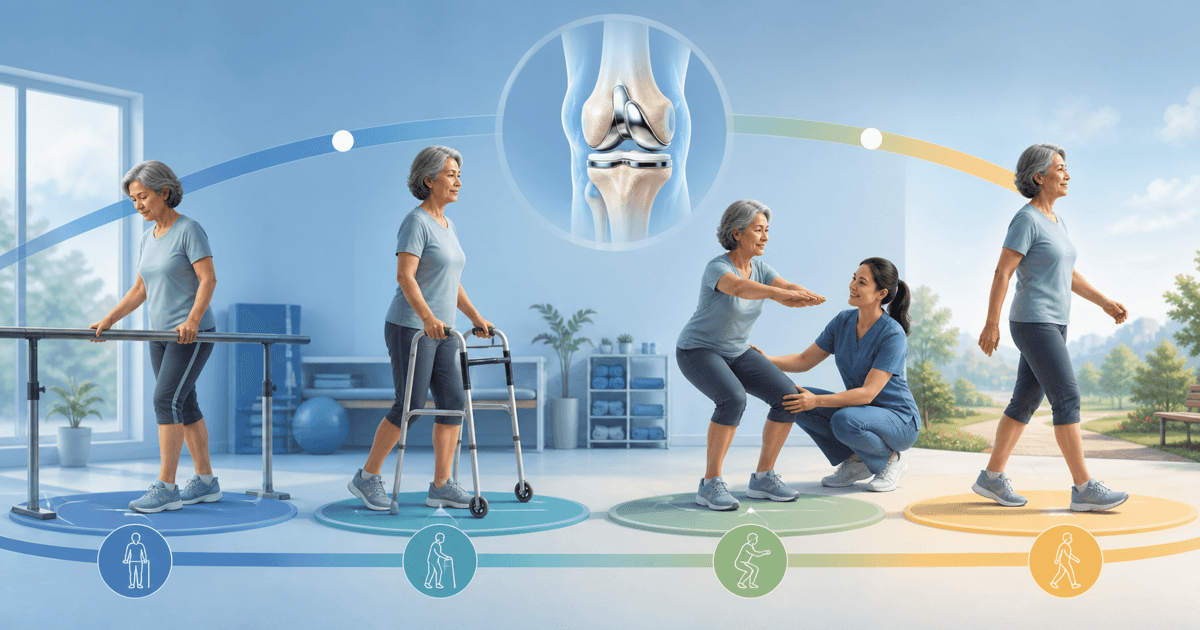
Why does the timeline vary?
Recovery depends on age, operation type, strength, weight, health, and wound healing. Rehabilitation participation also matters. Partial replacement may recover faster than total replacement. Any timeline is only a guide.
Many patients stand and walk soon after surgery. Taking several steps does not mean full recovery. Pain, swelling, poor sleep, and tiredness may improve over several months.
Surgery day to discharge: focus on safe movement
The care team helps patients stand and walk when safe. You may use a frame, crutches, or another aid. Early goals often include:
- controlling pain and nausea;
- getting in and out of bed safely;
- using the bathroom safely;
- practicing gentle movement and strengthening exercises;
- understanding wound care, medicines, and clot prevention;
- planning home help, exercises, and follow-up.
Hospital stay length varies with local rules and personal progress. Safe movement, pain control, and a workable home plan guide discharge.
The first two weeks: manage swelling and daily activity
Many people still use a walking aid at home. Increase activity according to your rehabilitation plan. Several short walks may feel easier than one long walk.
Keep the wound clean. Follow the exact dressing instructions from your hospital. Ice, elevation, and prescribed medicine may help swelling. Do not stop blood thinners or pain medicine without advice. Do not force the knee toward a fixed bend angle.
Weeks 3 to 6: becoming more independent
Some patients use walking aids less during this phase. The decision depends on gait, strength, balance, and medical advice. NHS guidance says some people try walking unaided around six weeks. This is not a deadline.
Rehabilitation often focuses on:
- straightening and bending the knee;
- strengthening the thigh and hip muscles;
- improving gait, balance, and stair technique;
- balancing activity with recovery time.
Driving requires safe reaction time, strength, and control. Sedating pain medicine can make driving unsafe. A clinician should confirm readiness.
Months 2 to 3 and beyond
Walking and lighter daily tasks usually keep improving. Desk jobs and physical jobs have different demands. NHS guidance gives a common return-to-work range of 6 to 12 weeks. Timing depends on the job and your recovery.
Full recovery can take several months or longer. Lower-impact activities may include walking, cycling, and swimming. Discuss running, jumping, high-impact sports, and heavy work with your surgeon.
Which changes need prompt medical advice?
Follow discharge instructions and seek prompt help for:
- increasing wound redness, drainage, separation, or fever;
- a sudden major increase in pain or swelling;
- new calf pain or major one-sided swelling;
- chest pain, trouble breathing, or coughing blood;
- inability to bear weight after a fall.
Recovery is not perfectly steady. Swelling can vary after activity. Sudden changes or whole-body symptoms need professional assessment.
Planning an international surgical trip
Plan accessible lodging, transportation, rehabilitation, follow-up, and safe return travel. Review our orthopedic services and joint replacement travel guide.
This article provides general rehabilitation education. Follow your surgical team's instructions. Activity and follow-up depend on your operation.