
On this pageHow is a condition like mine usually treated?
- 1.How is a condition like mine usually treated?
- 2.Which records affect the plan?
- 3.Treatment options and timing
- 4.When to discuss a second opinion or MDT
- 5.New medicines and other treatment options
- 6.Infection prevention, stamina and long-term follow-up
- 7.International department costs and budgeting
- 8.Which records to organise first
- 9.Common patient questions
- 10.How SinoCareHub can help
- 11.Sources and scope
01
How is a condition like mine usually treated?
First find the situation closest to your existing diagnosis. This section describes common treatment approaches; an individual plan also depends on pathology, tests and treatments already received.
New diagnosis with an unclear subtype
Confirm adequate tissue and classification first. 'Lymphoma' alone or one positive marker often cannot determine treatment. The hospital assesses sampling.
Some indolent lymphomas
Some low-burden patients without relevant symptoms can have observation. When treatment is needed, discuss antibodies, medicines or radiation. Obtain follow-up and treatment-start criteria for observation.
Aggressive disease or disease needing treatment
Plan by type, extent, risk and organs. Lymphoma stage Ⅳ is not directly comparable to solid tumour stage Ⅳ; goals and possible outcomes depend on subtype and other conditions.
Relapse, refractory disease or new changes after remission
Review progression and current type before comparing salvage medicines, transplantation, CAR-T or research. Remission duration, prior drugs and health affect choices.
02
Which records affect the plan?
Complete classification comes before mass size
Lymphoma combines morphology, immunohistochemistry and other necessary tests. Diffuse large B-cell and related types may need specific rearrangement testing. Double expression and double hit are different findings. Abbreviations cannot justify selecting intensive treatment yourself.
- Records to check
- Full pathology, immunohistochemistry and available flow, FISH or molecular results; borrow slides or blocks if required.
- Questions for your doctor
- Which subtype is diagnosed? Is tissue sufficient, and which plan-changing results need review?
Explain stage, risk and response separately
Imaging assesses distribution; risk scores also use age, performance status and LDH. PET-CT uptake and Deauville scores need interpretation by type and treatment point. Remaining bright areas alone do not establish failure.
- Records to check
- Original before-and-after PET-CT or other images, staging, risk, blood counts and LDH.
- Questions for your doctor
- Is this interim or end-of-course assessment? Would findings change cycles or need sampling?
Raise infections, cardiac health and fertility before medicines
Anti-CD20 and other treatments need hepatitis B and infection checks; some medicines need cardiopulmonary assessment. Explain medicines, fertility, transfusions and transplantation. Support is not an optional addition to omit casually.
- Records to check
- Completed infection and organ assessments, other conditions, all medicines, fertility wishes and prior care.
- Questions for your doctor
- What prevention, monitoring and fertility support are needed? Who handles fever after discharge?
03
Treatment options and timing
These regimens explain treatment components and timing; they are not individual prescriptions. A cycle includes recovery and assessment time and cannot be directly treated as the number of days in hospital or in China.
Observation or selected local treatment
Eligible indolent types or appropriate local disease, assessed by specialists.
Observation or selected local treatment
Eligible indolent types or appropriate local disease, assessed by specialists.
- Treatment details
- Some patients monitor without systemic medicines. Treatment may involve affected-site radiation, antibodies or other regimens. Some gastric MALT lymphomas require Helicobacter pylori management, not gastric adenocarcinoma pathways.
- Cycles and timing
- Observation has no fixed inpatient course. Specify follow-up, tests and treatment criteria. Local sessions and monitoring are separate and must continue at home.
Report new symptoms, masses or blood changes. Indolent disease may need reassessment or sampling. Initial pathology cannot permanently establish unchanged disease.
Immunochemotherapy for diffuse large B-cell lymphoma
Plan by stage, risk, molecular pathology and health. R-CHOP is a common Chinese guideline example.
Immunochemotherapy for diffuse large B-cell lymphoma
Plan by stage, risk, molecular pathology and health. R-CHOP is a common Chinese guideline example.
- Treatment details
- R-CHOP includes rituximab, relevant chemotherapy and steroids. Age, organs and molecular features can change medicines or intensity. B-cell lymphomas do not all use one regimen.
- Cycles and timing
- China's 2022 guideline includes 21-day R-CHOP. Some localised plans use 3 - 6 chemotherapy cycles, with antibodies or radiation according to criteria. Total counts depend on disease and assessment; not everyone receives 6.
Cycles include blood recovery and observation. Include infection prevention, tumour lysis risk, hepatitis B and cardiac monitoring. Seek timely care for fever or substantial symptoms as instructed.
Hodgkin chemotherapy and radiotherapy
Distinguish type, early-stage risk, bulky disease and response first.
Hodgkin chemotherapy and radiotherapy
Distinguish type, early-stage risk, bulky disease and response first.
- Treatment details
- China's 2022 classical Hodgkin examples include ABVD and interim-response-adjusted plans. Involved-site radiation depends on risk and response; R-CHOP cannot simply be applied.
- Cycles and timing
- The guideline's stage Ⅲ/Ⅳ classical Hodgkin example uses 6 ABVD cycles, with relevant response assessment after 2. Early plans differ; administration counts within cycles also need checking.
Discuss lung, heart, fertility and long-term effects alongside efficacy. Interim improvement does not justify deleting later treatment yourself; advanced stage does not mean no opportunity.
Regimens for T/NK-cell and other subtypes
Choice by full type, sites and risk; non-Hodgkin lymphomas are not all alike.
Regimens for T/NK-cell and other subtypes
Choice by full type, sites and risk; non-Hodgkin lymphomas are not all alike.
- Treatment details
- Some types need specialised combinations or local radiation, sometimes EBV assessment. Request medicines, goals and reassessment in writing rather than applying B-cell antibodies or CAR-T to all types.
- Cycles and timing
- Administration and admission vary, including continuous infusion, multiple days or radiation. No universal T/NK cycle count or total price exists.
Relapse may need pathology review and new comparison. Organs and previous effects matter. The platform does not prescribe intensity.
Salvage treatment and stem cell transplantation
Some relapsed or refractory cases by type, response and transplant eligibility.
Salvage treatment and stem cell transplantation
Some relapsed or refractory cases by type, response and transplant eligibility.
- Treatment details
- Salvage medicines may precede autologous transplantation for suitable patients. Allogeneic donor, risk and eligibility differ. Transplantation is neither node removal nor mandatory for every relapse.
- Cycles and timing
- Assess, give salvage care, collect cells or prepare donors, condition, infuse and recover in phases. Close follow-up continues after discharge. Infusion day or one admission cannot represent all time.
Include infection, blood recovery, organs and long-term care. Centers assess eligibility and donors, without guaranteed matches, beds or dates.
CAR-T and other new medicines
Some relapsed or refractory patients meeting product indications and center criteria.
CAR-T and other new medicines
Some relapsed or refractory patients meeting product indications and center criteria.
- Treatment details
- CAR-T can involve collection, manufacture, waiting-period care, lymphodepletion, infusion and monitoring. Products and subtypes are not interchangeable. Check bispecific administration, observation and Chinese indications individually.
- Cycles and timing
- The whole pathway is far longer than one infusion. Manufacturing, visits and admission depend on product and health, without universally promised weeks. Arrange monitoring before return.
Cytokine release, neurological and other risks need specialist monitoring. Quotes should include screening, collection, lymphodepletion, infusion, admission and possible complications, not only the cell product.
04
When to discuss a second opinion or MDT
Different classifications: request pathology review first
Experienced pathologists compare specimens and all tests and explain additional sampling. Treatment can differ greatly by type; clarify diagnosis before medicines.
Should ongoing interim PET uptake change treatment?
Provide original images, dosing dates and symptoms. Ask about score meaning, inflammation and further confirmation. Changes, radiation or completion of the original plan need specific evidence.
Compare transplantation, CAR-T and medicines after relapse
Use type, prior treatment, remission duration, health and current disease. Ask about screening, waiting-period management, risks, later alternatives and total costs together.
05
New medicines and other treatment options
Match new medicines to subtype and treatment lines
Antibodies, ADCs, bispecifics and cells have different criteria. Ask how previous medicines affect choice, current Chinese indications and assessment. One B-cell therapy cannot extend to every lymphoma.
Studies need waiting and non-enrolment plans
Screening may review tissue, targets and infection. Check recruitment, extra tests, fees and continuity after withdrawal. Do not pause necessary care while waiting yourself.
06
Infection prevention, stamina and long-term follow-up
Obtain fever and blood-change instructions
Reassess as directed and know when to seek care. Infection can affect the next course. Fever, chills or significant bleeding needs prompt team contact, without waiting for the platform or masking symptoms with antipyretics yourself.
Do not stop hepatitis B or other preventive medicines yourself
Pre-treatment screening and later monitoring may extend over time. Keep full antiviral records; teams decide stopping or adjustment. Travel and course completion are not reasons to stop yourself.
Follow fertility, fatigue and long-term effects too
Raise fertility before care and discuss stamina, heart, lung and function afterwards. Continue planned follow-up after imaging remission. Residual size or repeated self-arranged PET cannot be the only reassurance.
07
International department costs and budgeting
This page uses self-pay pricing for international departments / international medical services at Chinese hospitals. A verifiable published total price for a full course of care for Lymphoma has not yet been obtained. Ordinary outpatient, standard ward or insurance settlement amounts cannot be used as substitutes.
Available international department itemised charges
The following charges come from the International Medical Center at The University of Hong Kong-Shenzhen Hospital, published on 2025-06-04, using the amounts converted on 2026-10-12. They are references for itemizing a budget, do not represent prices at all hospitals and are not a package for Lymphoma.
| Item and scope | Reference amount (USD) |
|---|---|
| Specialist outpatient consultationPer consultation, with fees varying by doctor category. Tests, medicines and treatment are charged separately. | USD 90 - 300 |
| Adult inpatient consultationDaily consultation charge only. Beds, surgery, medicines and other charges are separate. | USD 150 - 220 |
| Single standard room bedPer bed per day, corresponding to Standard Room 1 and Standard Room 2 in the published schedule. Inpatient consultations and treatment are excluded. | USD 180 - 220 |
Converted using the reference exchange rate on 2026-10-12: USD 1 = CNY 6.6928, rounded to USD 10. Dollar amounts are for budgeting only. The hospital bills in its actual settlement currency; exchange rates and payment fees are separate.
Quote immunochemotherapy across complete cycles
Specify subtype, regimen, cycle strengths and quantities, adding infusion, supportive medicines, blood tests and response assessment. Separately list excluded radiation, pathology review, central nervous system prophylaxis or maintenance treatment.
Break transplantation into preparation, admission and follow-up
Autologous collection and storage, allogeneic donors, conditioning, infusion, isolation rooms, infection and monitoring differ in costs. Explain estimate basis and complications to the international department. Ordinary ward totals cannot substitute.
CAR-T budgets extend beyond product prices
Check screening, collection, manufacture, waiting medicines, lymphodepletion, infusion, observation, ICU or adverse events and charges after manufacturing failure, cancellation or delay. List medical, coordination and travel separately.
SinoCareHub helps obtain an itemised estimate from the prospective receiving international department, specifying the plan, date, validity period, included items and separately charged items. Hospital medical charges, platform coordination fees and third-party costs such as transport and accommodation are explained separately. The budget is updated if the treatment plan changes.
08
Which records to organise first
- Full classification, immunohistochemistry and completed FISH, flow or molecular tests.
- Original before-and-after imaging, stage, risk, blood counts, LDH and infection and organ assessments.
- Each medicine line, cycles, dates, radiation or transplant records and remission and progression times.
- Current infections, function, symptoms, all medicines, fertility and local ongoing medical resources.
First submit the records you already have and identify anything missing. The prospective receiving hospital decides whether additional tests or borrowing slides or paraffin blocks are needed for this assessment.
09
Common patient questions
Does stage Ⅳ lymphoma mean no curative opportunity?
Other cancers' meanings cannot be applied. Type, risk, health and response affect goals. Ask about your situation rather than predicting outcomes or survival from stage alone.
Why observe instead of immediate chemotherapy?
Some eligible indolent types can be observed. Clarify follow-up and treatment-start criteria. Return promptly for new symptoms or changes. Observation does not refuse all later care.
Does a remaining mass exclude remission?
Residual tissue may have different causes. Imaging also assesses metabolism, timing and evidence. Teams explain follow-up or sampling. Touch or diameter alone cannot justify adding cycles yourself.
Can every lymphoma have CAR-T?
No. Indications, targets, previous treatment and health are limited and product-specific. Submit full type and history for assessment. The lymphoma label alone cannot justify buying a course.
10
How SinoCareHub can help
SinoCareHub helps contact hospitals, organise records and coordinate care arrangements. The hospital is responsible for diagnosis and treatment decisions. The specific coordination services and fees are explained to you beforehand.
Collect subtype and the whole timeline
SinoCareHub helps organise pathology, tests, imaging and each line, follows specimen borrowing, submissions and translations, and notes infection and health.
Contact lymphoma specialists and consultation teams
Coordinate second opinions or MDTs for classification, response or relapse, following haematology, pathology, radiation and transplant or cell assessment as needed, with fees and written responses.
Follow phased scheduling and estimates
Coordinate tests and bookings with the center, checking cycles, collection, waiting and admission conditions. Obtain full medical estimates, explain coordination and third parties and follow changes.
Connect monitoring and return records
Arrange language support as agreed, helping record infection care, medicines and follow-up. Follow summaries and emergency care contacts. Medical teams arrange monitoring after return.
Submit an inquiry about care for Lymphoma
Describe your existing diagnosis, previous treatments and the question you want to address. You can submit an inquiry even if your records are incomplete. We will contact you to follow up on hospital assessment and care arrangements.
11
Sources and scope
Information checked: 2026-10-13. Treatment information identifies the guideline version; the hospital checks new drug indications and availability against current information. Costs use published international department itemised charges with clearly stated dates.
View medical references and image sources
- NCI · Stem Cell Transplants in Cancer Treatment ↗ (opens in a new window)National Cancer Institute · 2023-10-05
- NCI · CAR T Cells: Engineering Immune Cells to Treat Cancer ↗ (opens in a new window)National Cancer Institute · 2025-02-26
- National Health Commission · Lymphoma diagnosis and treatment guideline (2022) ↗ (opens in a new window)National Health Commission / Cancer Hospital, Chinese Academy of Medical Sciences · 2022
- National Health Commission · Diffuse large B-cell lymphoma diagnosis and treatment guideline (2022) ↗ (opens in a new window)National Health Commission / Cancer Hospital, Chinese Academy of Medical Sciences · 2022
- NCI · Non-Hodgkin Lymphoma Treatment ↗ (opens in a new window)National Cancer Institute
- The University of Hong Kong-Shenzhen Hospital · International Medical Center consultation and bed charges (published 2025-06-04) ↗ (opens in a new window)The University of Hong Kong-Shenzhen Hospital
- Investing.com · USD/CNY historical rates (conversion uses 6.6928 on 2026-10-12) ↗ (opens in a new window)Investing.com
- NCI · Clinical trial participation, costs and safety ↗ (opens in a new window)National Cancer Institute
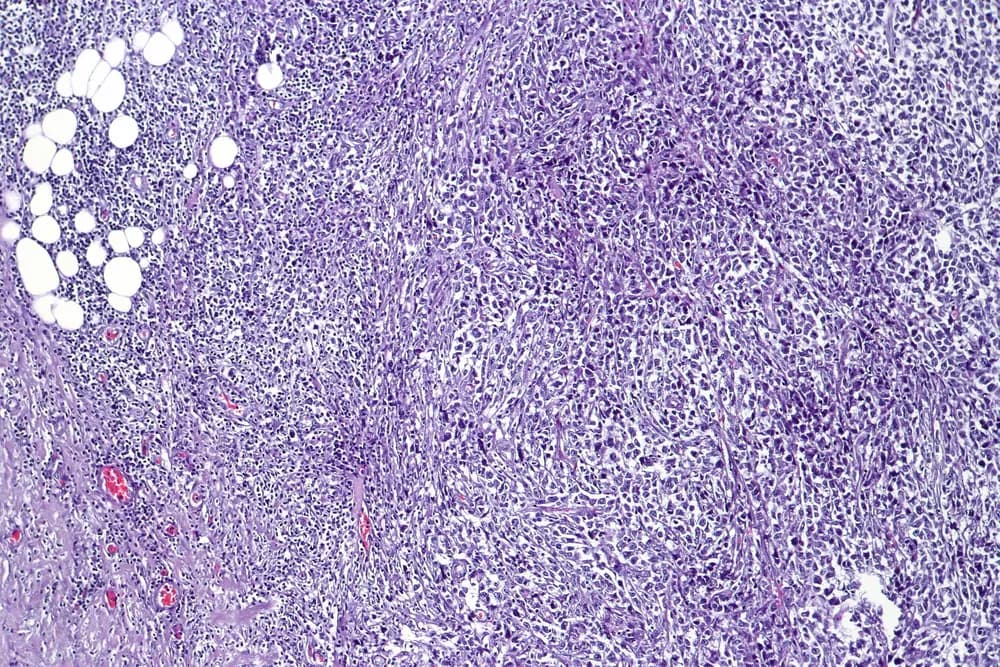
Micrograph: CoRus13 / Wikimedia Commons · CC BY-SA 4.0. The original image was resized and compressed to illustrate pathology testing. It is not used to assess an individual's condition.
This page was compiled by SinoCareHub and does not claim review by an external medical expert. General information cannot replace individual diagnosis, prescriptions or emergency care. If an acute change occurs, contact a local medical institution without waiting for a platform response.