
On this pageHow is a condition like mine usually treated?
- 1.How is a condition like mine usually treated?
- 2.Which records affect the plan?
- 3.Treatment options and timing
- 4.When to discuss a second opinion or MDT
- 5.New medicines and other treatment options
- 6.Swallowing, feeding tubes and post-operative reflux
- 7.International department costs and budgeting
- 8.Which records to organise first
- 9.Common patient questions
- 10.How SinoCareHub can help
- 11.Sources and scope
01
How is a condition like mine usually treated?
First find the situation closest to your existing diagnosis. This section describes common treatment approaches; an individual plan also depends on pathology, tests and treatments already received.
Superficial lesions with low nodal risk
Some can be removed endoscopically. Depth, margins, lymphovascular invasion and full pathology determine further treatment. Small size alone cannot exclude surgery.
Operable local disease
Compare immediate surgery with pre-operative medicines or chemoradiotherapy. Locally advanced patients often need combined treatment. Pathology and prior treatment determine post-operative steps.
Locally advanced disease without planned or feasible surgery
If fit enough, discuss definitive concurrent chemoradiotherapy. Completion depends on nutrition, heart and lung function and complications. Avoiding one operation does not necessarily make treatment easier.
Recurrence or distant metastasis
Systemic medicines and symptom care predominate, guided by prior treatment. Swallowing, pain, bleeding and nutrition need simultaneous management.
02
Which records affect the plan?
Establish squamous or glandular type and location
Squamous carcinoma is more common in China, but individual type still requires pathology. Cervical, thoracic, lower oesophageal and junction lesions differ in management. Some adenocarcinoma tests and medicines also differ.
- Records to check
- Endoscopic location, type, lesion boundaries and junction relationship, and existing immune or molecular tests.
- Questions for your doctor
- How do my type and location affect surgery, radiation fields and medicines?
Surgical feasibility needs imaging and health assessment
Relationships to the trachea, major vessels and other adjacent structures, nodes and distant lesions affect complete resection. Heart and lung function and previous chest treatment also matter. One stage number is insufficient.
- Records to check
- Original staging images, available endoscopic ultrasound, cardiopulmonary and other illness information and previous radiation.
- Questions for your doctor
- Why is surgery unsuitable? Is reassessment planned after initial treatment?
Swallowing and nutrition are part of preparation
Explain whether ordinary food, liquids or even water are difficult, with choking, vomiting and weight loss. Nutrition may need arranging first, depending on obstruction and surgery or radiation plans.
- Records to check
- Recent weight and intake, nutrition assessment, existing stents or feeding tubes and procedure records.
- Questions for your doctor
- How will intake be maintained? Do I need tube feeding or another procedure, and will it affect treatment?
03
Treatment options and timing
These regimens explain treatment components and timing; they are not individual prescriptions. A cycle includes recovery and assessment time and cannot be directly treated as the number of days in hospital or in China.
Endoscopic resection of early lesions
Some superficial lesions meeting depth and low-metastasis-risk criteria.
Endoscopic resection of early lesions
Some superficial lesions meeting depth and low-metastasis-risk criteria.
- Treatment details
- Endoscopic mucosal resection or submucosal dissection may be used, with full pathology determining adequacy. Deeper invasion, margins or lymphovascular findings may require surgery or chemoradiotherapy.
- Cycles and timing
- Time assessment, procedure, pathology and follow-up separately. Extensive resection needs stricture monitoring and possible later treatment. Ordinary gastroscopy timing is insufficient.
Preserving the oesophagus does not eliminate stricture or recurrence risk. Ask when swallowing changes warrant review and where reassessment or dilation occurs.
Oesophagectomy and digestive reconstruction
Patients assessed as completely resectable and fit for surgery.
Oesophagectomy and digestive reconstruction
Patients assessed as completely resectable and fit for surgery.
- Treatment details
- Resect relevant oesophagus and nodes and rebuild the food passage with stomach or other tissue. Open, endoscopic and robotic approaches still need explanation of extent, anastomosis location and respiratory or anastomotic problems.
- Cycles and timing
- Arrange pre-operative treatment, admission, swallowing recovery, final pathology and further treatment separately. China's 2022 guideline recommends assessment about 1 month after pre-operative radiation and surgery 4 - 8 weeks after completion for eligible patients.
Intervals assume recovery and reassessment and are not fixed booking promises. Ask about feeding tubes, breathing exercises, reflux and extended admission. The team assesses travel by recovery.
Pre-operative or definitive concurrent chemoradiotherapy
Pre-operative treatment for some locally advanced disease or tolerable combined treatment when surgery is impossible or not planned.
Pre-operative or definitive concurrent chemoradiotherapy
Pre-operative treatment for some locally advanced disease or tolerable combined treatment when surgery is impossible or not planned.
- Treatment details
- Radiation accompanies appropriate chemotherapy, such as paclitaxel with platinum. Pre-operative and definitive plans have different goals and irradiation. A package cannot replace an individual plan.
- Cycles and timing
- China's 2022 guideline conventional examples use 5 sessions weekly. A definitive plan may use about 30 sessions, taking about 6 weeks at this frequency. Simulation, planning, pauses and later assessment are additional.
Painful swallowing and reduced blood counts may affect intake and scheduling. The hospital needs clear nutrition and symptom contacts. Do not interrupt treatment to meet a return flight.
Systemic medicines after recurrence or metastasis
Choice by pathological type, prior treatment, tests and health.
Systemic medicines after recurrence or metastasis
Choice by pathological type, prior treatment, tests and health.
- Treatment details
- China's 2022 guideline includes some immune-chemotherapy options; squamous cancer may discuss camrelizumab with paclitaxel and cisplatin. Junction adenocarcinoma and HER2 regimens need separate assessment. Names are not prescriptions.
- Cycles and timing
- Specify intervals, initial cycles, reassessment and maintenance for each medicine. Progression after prior immunotherapy or chemotherapy needs renewed next-line discussion, not copied first-treatment cycles and costs.
Immune effects can differ from ordinary chemotherapy reactions. Check current Chinese indications and supply, with ways to report symptoms, reassess and continue medicines between countries.
Swallowing difficulty and nutritional support
Inadequate intake or obstruction, with timing decided by the team.
Swallowing difficulty and nutritional support
Inadequate intake or obstruction, with timing decided by the team.
- Treatment details
- Discuss feeding tubes, stents, local treatment or other support according to the condition. Stents have specific indications and risks, not one answer for everyone with dysphagia.
- Cycles and timing
- Support may start before anticancer treatment and change with swallowing and weight. Schedule device care, supplies, follow-up and repeat procedures separately.
Inability to swallow water, significant bleeding or choking with breathing problems needs prompt local care. Routine platform enquiries cannot replace acute assessment.
04
When to discuss a second opinion or MDT
Choosing between surgery and chemoradiotherapy
Ask thoracic surgery, radiation and oncology teams to jointly explain resectability, type, health and nutrition. Request written sequence and options if disease remains after treatment.
Can surgery be omitted when lesions disappear after pre-operative treatment?
Improved imaging or endoscopy does not prove absence of residual disease. Submit before-and-after records to discuss assessment reliability, evidence for surgery or alternatives and the corresponding follow-up burden.
New local problems after previous radiotherapy
Provide the full old plan, dose summary, imaging and swallowing status for assessment of recurrence, stricture or other causes. Repeat surgery, radiation and stents differ in risk. One new image cannot establish arrangements.
05
New medicines and other treatment options
Post-operative and metastatic immunotherapy differ
Check previous chemoradiotherapy, resection pathology, residual disease and current Chinese indications first. Advanced-disease evidence for a medicine cannot directly replace adjuvant eligibility.
Trials must match your treatment history
Squamous versus glandular type, surgery, radiation and immune medicines may affect screening. Ask about screening, allocation, research and routine care costs, visits and arrangements after withdrawal.
06
Swallowing, feeding tubes and post-operative reflux
Intake records are more useful than 'eating reasonably well'
Record food textures, choking, eating pain and weight daily. Obtain diet progression and nutrition plans, reassessing worsening swallowing. Do not force hard foods yourself.
Arrange tube care before returning home
Obtain tube type, use, cleaning, supplies and abnormality contacts. Removal depends on intake and recovery, not trip-end dates. Confirm local care continuity before return.
Report reflux and respiratory problems promptly
Reconstruction may require changes in meal size, posture and medicines. Persistent choking, chest pain, fever or substantial breathlessness needs prompt care. Not every symptom is normal recovery.
07
International department costs and budgeting
This page uses self-pay pricing for international departments / international medical services at Chinese hospitals. A verifiable published total price for a full course of care for Oesophageal cancer has not yet been obtained. Ordinary outpatient, standard ward or insurance settlement amounts cannot be used as substitutes.
Available international department itemised charges
The following charges come from the International Medical Center at The University of Hong Kong-Shenzhen Hospital, published on 2025-06-04, using the amounts converted on 2026-10-12. They are references for itemizing a budget, do not represent prices at all hospitals and are not a package for Oesophageal cancer.
| Item and scope | Reference amount (USD) |
|---|---|
| Specialist outpatient consultationPer consultation, with fees varying by doctor category. Tests, medicines and treatment are charged separately. | USD 90 - 300 |
| Adult inpatient consultationDaily consultation charge only. Beds, surgery, medicines and other charges are separate. | USD 150 - 220 |
| Single standard room bedPer bed per day, corresponding to Standard Room 1 and Standard Room 2 in the published schedule. Inpatient consultations and treatment are excluded. | USD 180 - 220 |
Converted using the reference exchange rate on 2026-10-12: USD 1 = CNY 6.6928, rounded to USD 10. Dollar amounts are for budgeting only. The hospital bills in its actual settlement currency; exchange rates and payment fees are separate.
Oesophageal surgery quotes need reconstruction and recovery
Check extent, reconstruction, anaesthesia, consumables, pathology, rooms, nutrition and monitoring. Clarify additional ICU, anastomotic problem, extended admission and further treatment costs rather than only endoscopic or robotic fees.
List both chemoradiotherapy components
Quote radiation simulation, planning, irradiation and verification separately from chemotherapy medicines, infusion and blood tests. Include total session counts, charging boundaries for possible pauses or replanning, and nutritional support during treatment.
Separate feeding tubes, stents and ongoing supplies
After procedures, devices, anaesthesia and consumables, costs may include nutrition formulas, care, follow-up and repeat procedures. Obtain a current-phase estimate and check supply and care at home beforehand.
SinoCareHub helps obtain an itemised estimate from the prospective receiving international department, specifying the plan, date, validity period, included items and separately charged items. Hospital medical charges, platform coordination fees and third-party costs such as transport and accommodation are explained separately. The budget is updated if the treatment plan changes.
08
Which records to organise first
- Endoscopic images and location, full pathology and completed relevant tests.
- Original before-and-after images, cardiopulmonary and other illness information.
- Surgery and reconstruction, original radiation plans and summaries, and all medicine dates and responses.
- Recent intake, weight and choking, stent or tube records and current medicines.
First submit the records you already have and identify anything missing. The prospective receiving hospital decides whether additional tests or borrowing slides or paraffin blocks are needed for this assessment.
09
Common patient questions
Does worse swallowing after radiation mean treatment failed?
Causes may include reactions, narrowing or disease changes. Do not conclude yourself. Report onset, ability to drink and weight, and undergo assessment. Substantial inability to drink needs prompt care.
Is tumour treatment still needed after a stent?
A stent mainly relieves obstruction for some patients; it does not eliminate systemic or local tumour. The team decides next treatment using disease, intake and stent risks.
Why do other oesophageal cancer patients avoid surgery?
Location, type, resectability, cardiopulmonary function and preferences can differ. Check both patients' conditions before comparison. Another sequence does not establish that yours is wrong.
Can I immediately return home after chemoradiotherapy?
Swallowing, intake, blood counts and later assessment still matter. Planned surgery also needs reassessment and operative windows. Obtain an individual stay and continuity plan; the final radiation session is not travel clearance.
10
How SinoCareHub can help
SinoCareHub helps contact hospitals, organise records and coordinate care arrangements. The hospital is responsible for diagnosis and treatment decisions. The specific coordination services and fees are explained to you beforehand.
Complete location, pathology and swallowing records
SinoCareHub helps organise endoscopy, pathology, imaging and previous care, explains actual intake and support, and follows hospital review, submissions and translation.
Coordinate surgery and chemoradiotherapy second opinions
Request hospital MDT or specialist views on resectability, sequence or options after radiation, following departments, format, scheduling, charges and written conclusions.
Connect nutrition, appointments and budgets
Coordinate assessment, nutrition appointments and treatment according to the plan and obtain itemised estimates. Separate pre-operative treatment, surgery, chemoradiotherapy and tube or stent costs, following updates after changes.
Record care and return handover
Arrange language and accompaniment as agreed, helping record tubes, diet, medicines and abnormality instructions. Follow radiation or surgery summaries and local reassessment information. Hospitals manage medical care.
Submit an inquiry about care for Oesophageal cancer
Describe your existing diagnosis, previous treatments and the question you want to address. You can submit an inquiry even if your records are incomplete. We will contact you to follow up on hospital assessment and care arrangements.
11
Sources and scope
Information checked: 2026-10-13. Treatment information identifies the guideline version; the hospital checks new drug indications and availability against current information. Costs use published international department itemised charges with clearly stated dates.
View medical references and image sources
- National Health Commission · Oesophageal cancer diagnosis and treatment guideline (2022) ↗ (opens in a new window)National Health Commission / Cancer Hospital, Chinese Academy of Medical Sciences · 2022
- NCI · Esophageal Cancer Treatment ↗ (opens in a new window)National Cancer Institute
- The University of Hong Kong-Shenzhen Hospital · International Medical Center consultation and bed charges (published 2025-06-04) ↗ (opens in a new window)The University of Hong Kong-Shenzhen Hospital
- Investing.com · USD/CNY historical rates (conversion uses 6.6928 on 2026-10-12) ↗ (opens in a new window)Investing.com
- NCI · Clinical trial participation, costs and safety ↗ (opens in a new window)National Cancer Institute
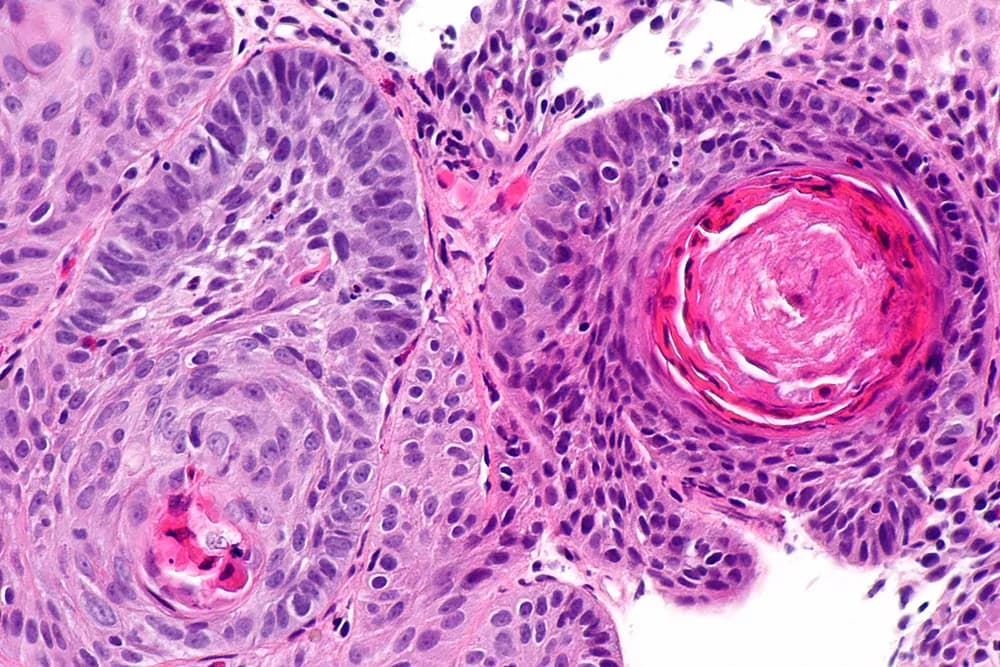
Micrograph: Nephron / Wikimedia Commons · CC BY-SA 3.0. The original image was resized and compressed to illustrate pathology testing. It is not used to assess an individual's condition.
This page was compiled by SinoCareHub and does not claim review by an external medical expert. General information cannot replace individual diagnosis, prescriptions or emergency care. If an acute change occurs, contact a local medical institution without waiting for a platform response.