
Visit preparation
If you can walk after lumbar surgery, can you fly home?
Being able to walk after lumbar surgery is not enough to book a return flight. Your wound, nerve function and activity restrictions throughout the journey also need assessment.
First, identify the operation you had
“Lumbar surgery” does not mean everyone starts recovery from the same point. The NHS explains that lumbar decompression may involve removing part of a vertebral arch, and sometimes part of a disc. The hospital should also explain wound care and activities to avoid during recovery.[3] If your discharge record also says “bone graft fusion” or “internal fixation”, do not copy the travel arrangements of someone who had decompression alone.
If you had posterior short-segment lumbar decompression and fusion in China, the National Health Commission's 2023 clinical pathway can help you understand discharge assessment: it covers the wound, pain, nerve function and imaging of the internal fixation.[1] This pathway does not set a universal number of days before flying after surgery. Length of hospital stay must not be treated as a no-fly period.
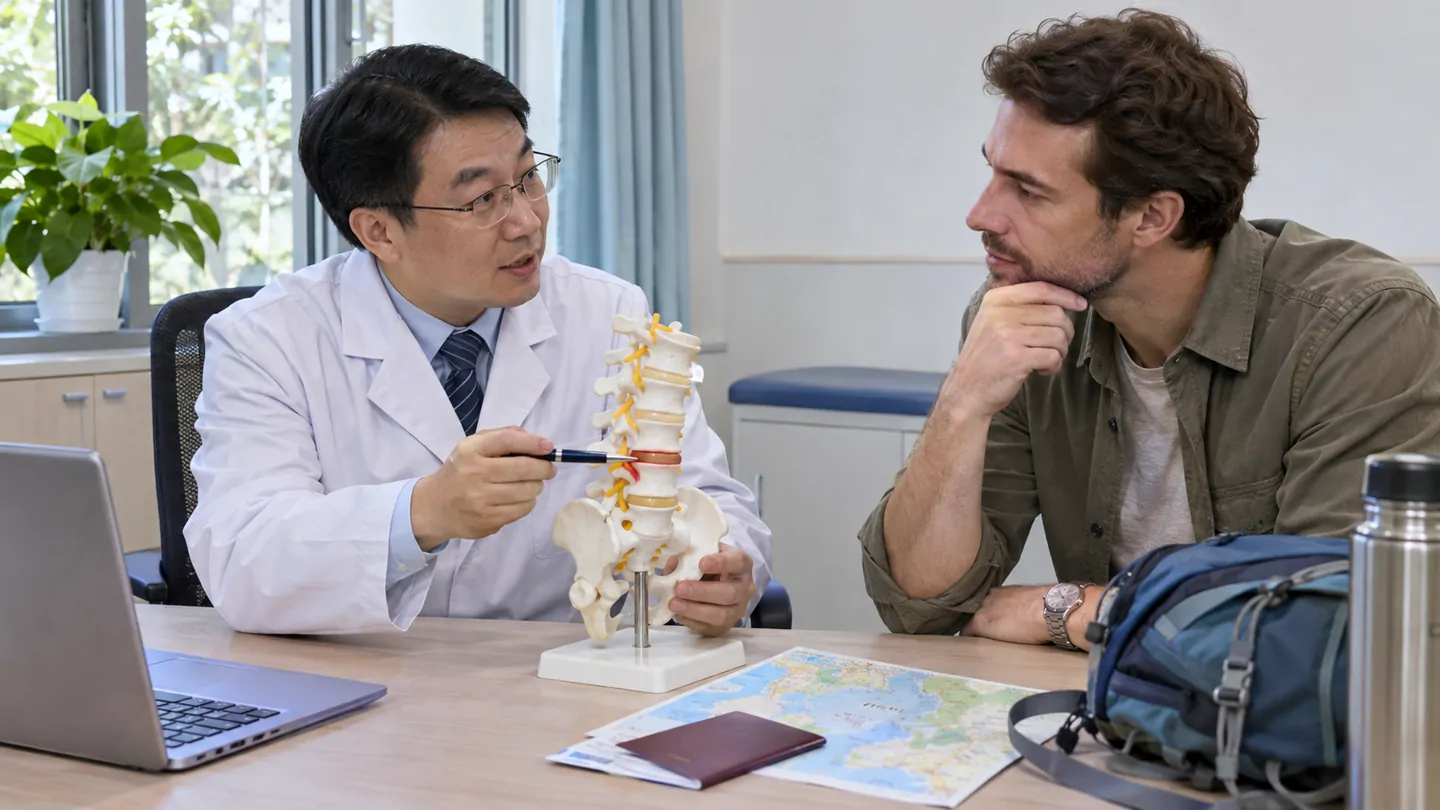
Walking and completing a journey are different
Cambridge University Hospitals' recovery guidance after lumbar decompression encourages gradually increasing walking, while avoiding heavy lifting and excessive pushing, pulling, bending and twisting early in recovery.[2] Walking from a ward into a corridor involves different movements from leaving a hotel, going through security, getting into and out of a seat and finally reaching home. Telling your surgical team which movement is hardest is more useful than only asking, “On which day can I fly?”
| Practical difficulty | How it affects the journey home | What to explain during assessment |
|---|---|---|
| You can walk a short distance, but sitting down, standing up or turning hurts | Moving into and out of seats may still be limited | Which movements hurt and whether someone needs to help you |
| You can sit and walk, but cannot lift a suitcase or bend | Handling luggage may exceed your permitted activities | Who will lift bags, retrieve items and arrange transport |
| You develop new leg weakness or numbness | Nerve function needs reassessment | When the new symptoms started and whether they are worsening |
Breaking the journey down by movement is a preparation method based on postoperative restrictions and warning symptoms, not a test for deciding for yourself whether you are fit to fly.[2][3] Without your team's agreement, do not repeatedly try sitting or lifting weights to meet a flight schedule.
Do not add medication yourself to prevent blood clots
Spinal surgery and reduced activity both increase the risk of blood clots in the legs or lungs, as Cambridge University Hospitals explicitly warns.[2] The National Health Commission's fusion pathway requires repeat ultrasound of the leg veins on the day before discharge or the day of discharge for patients at high risk of thrombosis. Bleeding risk must also be assessed when considering anticoagulation.[1]
Walking less after discharge is therefore not the only way to “protect your back”, and taking extra anticoagulants yourself is not preparation for flying. Ask the surgical team to explain preventive arrangements in light of your actual mobility. Follow the prescribed plan for your medication, compression stockings and activity. If you develop calf swelling, chest tightness or difficulty breathing, seek medical care immediately instead of continuing to catch your flight.[2]
What to hand over before leaving China
The National Health Commission pathway requires patients to be told about follow-up timing, continued rehabilitation exercises and brace use. When to stop using a brace is generally decided after outpatient reassessment.[1] Before travelling home, ask the hospital to put these instructions in your discharge documents and specify where your next examination will take place and who will review the results.
The records for the doctor taking over your care at home should explain the operation actually performed and the postoperative assessment, especially whether you had fusion or internal fixation and what activity restrictions currently apply. If you are still unsure of the operation's name, read the difference between lumbar endoscopy and fusion with internal fixation, then compare this with your surgical record and ask your responsible team. This article does not replace individual clearance to travel home.
Frequently asked question
After lumbar decompression, can clear wound fluid and a headache wait until follow-up at home?
Do not wait for your return journey. Cambridge University Hospitals advises immediate assessment in an emergency department if clear fluid leaks from the wound with a headache or fever.[2]
Need help?
Tell us about your situation and needs. Incomplete records are welcome.
Related reading
Sources and references
- National Health Commission of China: Enhanced recovery clinical pathway for posterior short-segment lumbar decompression and fusion (2023 edition).
- Cambridge University Hospitals: Post-operative recovery following lumbar decompression surgery; approved 2023-02-22.
- NHS: Lumbar decompression surgery; reviewed 2026-03-10.