
Medication
Bringing insulin to China: how should you store it on the journey?
Carry insulin with you and prevent freezing. Check the product-specific storage conditions separately for unused insulin and insulin already in use.
Identify which insulin is already in use
Separate the insulin you are using from your spare supplies before travelling. Patient information published by the Capital Institute of Pediatrics in 2025 states that unopened insulin should be refrigerated at 2–8°C, away from cooling elements. Storage periods after opening differ between products; follow the package leaflet. Storage guidance
There may be plenty of insulin left in a cartridge, but that does not establish how much longer it can be stored. Check the printed expiry date and the in-use time limit separately. You can mark the first-use date on the box and photograph the storage section of the leaflet. If you help a family member manage supplies, retain both dates rather than planning the return journey solely around the amount remaining.
This article concerns insulin preparations carried with you. Insulin in a pump and other refrigerated injectable medicines have their own product and device requirements. The figures here cannot simply be applied to them.
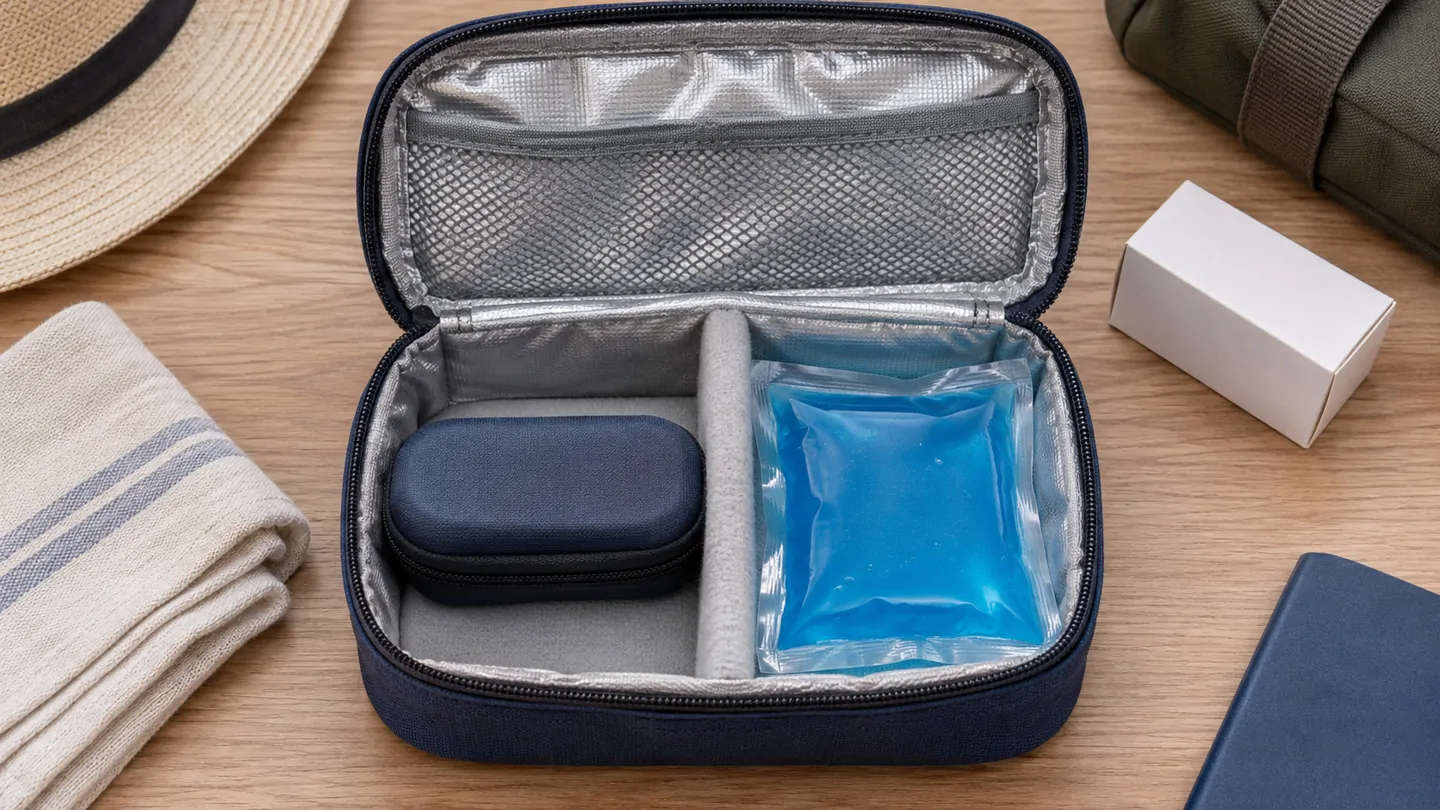
A cool bag must protect against freezing as well as heat
Beijing Youan Hospital's 2025 travel guidance recommends an insulated cool bag, with a towel or a purpose-built divider separating the medicine from ice packs. Insulin touching an ice pack may become too cold locally. Ice remaining in a bag does not establish that the medicine is at a suitable temperature. Cool-bag and carry-on guidance
Include connections, transport waits and the trip to your hotel in the storage plan. Keep the medicine with you rather than leaving it in a parked vehicle or putting it in checked baggage. When choosing a bag, examine how it separates the medicine from the coolant, rather than relying only on an advertised cooling duration. Confirm security requirements for needles and ice packs with the actual carrier for your international flight; this article has not verified individual routes.
How long can insulin be kept after first use?
There is no universal rule that every insulin can stay at room temperature for a month. The human insulin injection leaflet published on HEC Pharm's Chinese website specifies 28 days at no more than 25°C after first use for its 3 mL:300-unit cartridge. If room temperature exceeds 25°C, that product's instructions require refrigeration and allowing it to return to room temperature before each use. Product leaflet: storage
The following comparison applies only to the product in that leaflet. It is not a storage table for insulin glargine or other cartridges.
| Comparison | This product before first use | This product after first use |
|---|---|---|
| Temperature | Refrigerate at 2–8°C; do not freeze | Up to 28 days at no more than 25°C; at higher room temperatures, refrigerate as directed in this leaflet |
| Light protection | Keep the cartridge in its box; avoid sunlight and excessive heat | Continue to avoid sunlight and excessive heat |
| Date to check | Printed expiry date | First-use date and in-use limit |
The publicly available manufacturer's document carries a revision date of 22 June 2021. If you receive a different product in China, ask the dispensing pharmacist to point out the relevant instructions in its own leaflet. Do not apply this 28-day limit to every new product.
What should you arrange at the hotel?
Identify the refrigerator compartment and cooling elements before storing spare insulin. The Capital Institute of Pediatrics recommends placing a thermometer inside the refrigerator; Youan Hospital advises against putting insulin directly against its inner wall. A small refrigerator being able to cool does not mean the spot where the medicine is kept always meets its storage requirements. Thermometer guidance | Hotel storage guidance
If the medicine freezes or experiences an unsuitable temperature during travel, show the treating doctor or pharmacist the affected box, first-use date, and any known temperature and duration. The manufacturer's leaflet states that insulin that has frozen must not be used. When a temperature excursion is uncertain, contact a professional to assess it and arrange subsequent medication. Normal appearance alone cannot establish potency, and you should not increase the dose yourself to compensate.
Bring your original prescription and recent blood glucose records to the appointment so the team can distinguish storage problems from other influences on glucose levels. For help coordinating care in China, explain your current medicine and continuity needs through SinoCareHub's care coordination contact; an adviser can then explain how to send records. Medicine-quality assessment and prescribing remain the medical team's responsibility. For recognizing concentration labels on Chinese packs, see insulin glargine U100 and U300.
Frequently asked questions
Which limit applies if Chinese and overseas insulin packs give different storage periods?
First identify the actual product and whether it is in use. Ask the dispensing pharmacist to explain its leaflet. Do not borrow a longer limit from another product. Source
Should I keep the same injection time when crossing time zones to China?
Do not calculate the change yourself. This leaflet warns that time-zone travel can disrupt meals and medication schedules. Obtain individual instructions from your doctor before departure. Source
Should I remove the needle before putting an insulin pen in my bag?
The cited human insulin cartridge leaflet requires removing the needle after each injection to prevent leakage affecting the dose. Follow the instructions for any other device you use. Source
Need help?
Tell us about your situation and needs. Incomplete records are welcome.