
Visit preparation
Cannot raise your shoulder: should you keep doing wall climbs?
If shoulder pain stops you raising your arm, do not force wall-climbing exercises. Whether exercise is suitable depends on whether you have frozen shoulder, an accompanying rotator cuff injury, and the stage of pain.
First distinguish pain from stiffness
Increasing difficulty dressing or combing your hair often makes people think of “periarthritis of the shoulder”. But this commonly used label can mix together different causes. Frozen shoulder often limits movement in several directions; rotator cuff tears and cervical spine conditions can also cause shoulder pain. Age, night pain or difficulty raising an arm alone cannot establish the cause.[1,3]
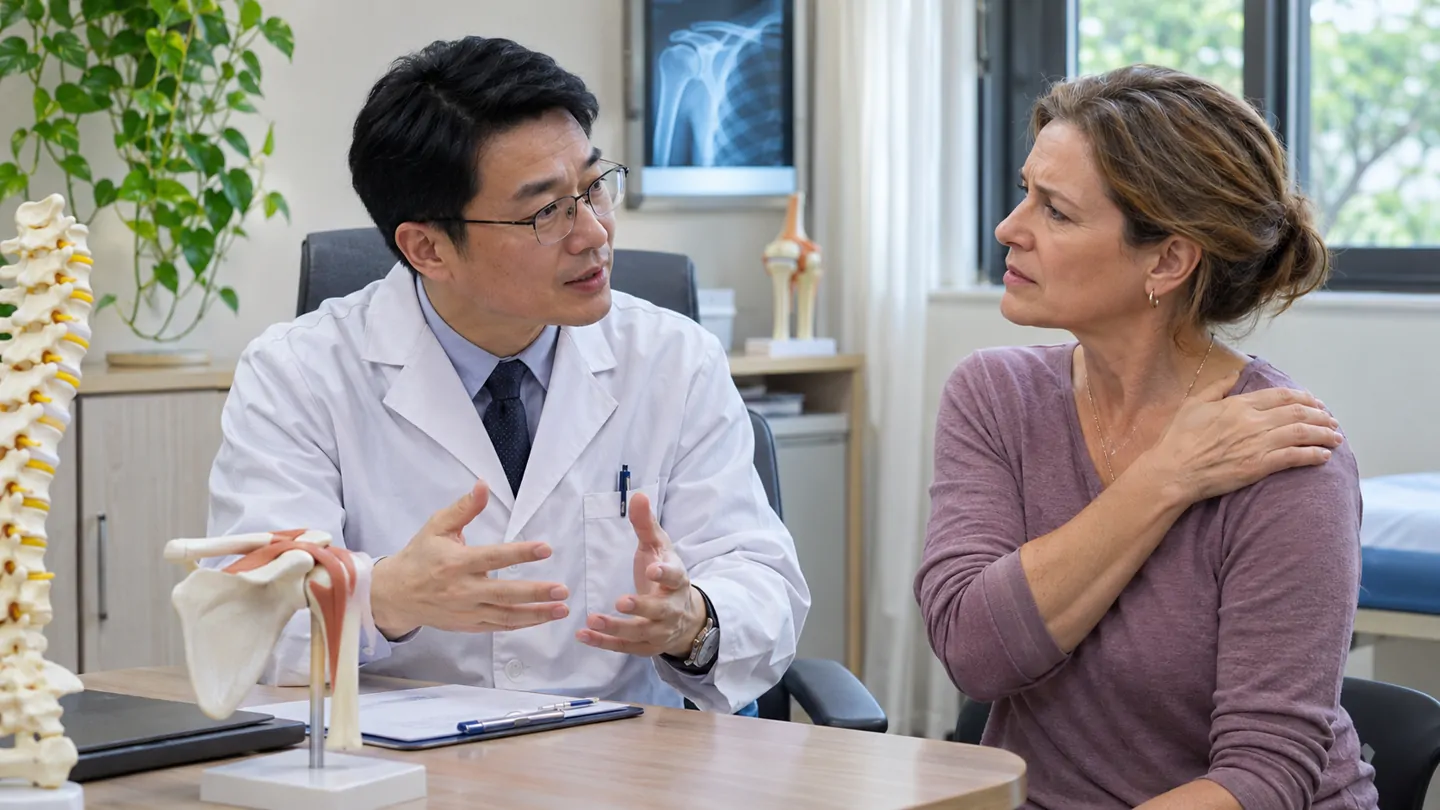
Doctors assess active and passive movement separately: active movement means raising your arm yourself; passive movement means an examiner helps move the shoulder joint. Frozen shoulder can restrict both, particularly outward rotation and reaching behind your back. This distinction is part of a professional examination; family members should not force your shoulder to test it.[1,3]
If you are preparing for a follow-up consultation in China, record when the pain began, whether there was an injury, and which everyday movements you cannot perform. Bring reports and original images from any previous ultrasound or magnetic resonance imaging (MRI). First consult orthopaedics, a shoulder specialist or sports medicine to establish the cause, then determine the direction of rehabilitation.[1,3]
Less pain can still mean more stiffness
Pain and stiffness in frozen shoulder do not always change together. Night pain may be prominent during the painful phase. As the shoulder enters the stiff phase, pain may ease while the range of movement continues to shrink. “It hurts less today” does not by itself mean recovery, and reaching higher should not be the only training goal.[1,3]
Difficulty raising an arm can call for different priorities:
| Current situation | Assessment priority | How exercise planning changes |
|---|---|---|
| Severe pain with movement, disturbed nights | Source of pain and current phase | Control pain first; avoid movements that cause severe pain |
| Less pain, but rotating the shoulder or reaching behind the back remains difficult | Degree of joint movement restriction | After diagnosis, plan gentle, gradual movement |
| Confirmed or suspected accompanying rotator cuff injury | Tendon condition and cause of weakness | Reassess overhead exercises; do not simply copy a wall-climbing programme |
This table explains consultation priorities; it is not a tool for deciding your own disease stage.[1–3]
More pain does not make wall climbs more effective
Shoulder-pain education from the Eye Hospital of China Academy of Chinese Medical Sciences warns about inappropriate loading during wall climbs when rotator cuff injury is also present. The key is to identify the cause first, then let the treating team choose the movements. The fact that frozen shoulder needs rehabilitation does not mean all shoulder pain needs the same stretching.[2]
Exercise after diagnosis also needs to match the phase. When acute pain is prominent, protection and pain management take priority. When restoring movement is appropriate, gentle stretching can be introduced gradually. Do not have someone pull your shoulder forcefully, or repeatedly exercise through severe pain just to reach higher than yesterday.[2]
Education from Beijing Tsinghua Changgung Hospital also notes that movement should not worsen night pain. If pain is worse that night after exercise and affects sleep, report the change to your rehabilitation or treating team so the plan can be adjusted. At follow-up, ask specifically: “Is pain or joint stiffness mainly limiting me now? Which movements can I do, and what reactions mean the plan needs adjusting?”[3]
Frequently asked questions
Can I leave frozen shoulder untreated and wait for it to improve?
Some patients gradually improve, but others have lasting pain and restricted movement. If dressing, combing your hair or sleep is affected, seek medical assessment.[3]
If I cannot raise my shoulder, do I definitely need an MRI?
No. Doctors first assess your history and examine you. X-rays, ultrasound and MRI serve different purposes; the doctor decides whether they are needed.[1]
Does a frozen shoulder diagnosis mean my rotator cuff must be fine?
No. Both conditions can coexist. If weakness develops or pain worsens after exercise, return for reassessment rather than continuing the same wall climbs.[1,2]
Need help?
Tell us about your situation and needs. Incomplete records are welcome.
Related reading
Sources and references
- National Clinical Research Center for Geriatric Disorders, Xiangya Hospital, Central South University: Shoulder too stiff to raise? Published 2026-10-23.
- Beijing Municipal Health Commission, reposting the Eye Hospital of China Academy of Chinese Medical Sciences: Exercise or rest? Page dated 2025-09-12.
- Beijing Municipal Health Commission, reposting Beijing Tsinghua Changgung Hospital: How can shoulder periarthritis be prevented? Published 2022-06-21.