
Visit preparation
My fracture is not healing. Do I need another operation?
A fracture that is slow to heal does not always need another operation. The decision requires comparison of earlier images and assessment of fixation, blood supply and infection.
Slow healing or no further healing?
Delayed union means that a fracture is healing more slowly than expected. Nonunion means that it has not healed and is unlikely to continue healing on its own. The distinction affects continued observation and the need for revision. Fracture location and injury severity vary, so elapsed time alone cannot establish the diagnosis. WashU orthopedic patient information
A useful first question at follow-up is: has new bone connected the fracture ends since the previous examination? The doctor compares images from different dates alongside pain and use of the limb. A gap on one image and a lack of healing progress across repeated examinations provide different information. AAOS: nonunions
When organizing your records, keep more than the latest report. Match the injury, first operation and each follow-up date to the original images. Report persistent pain, but do not try walking or twisting the injured limb to test whether it has healed.
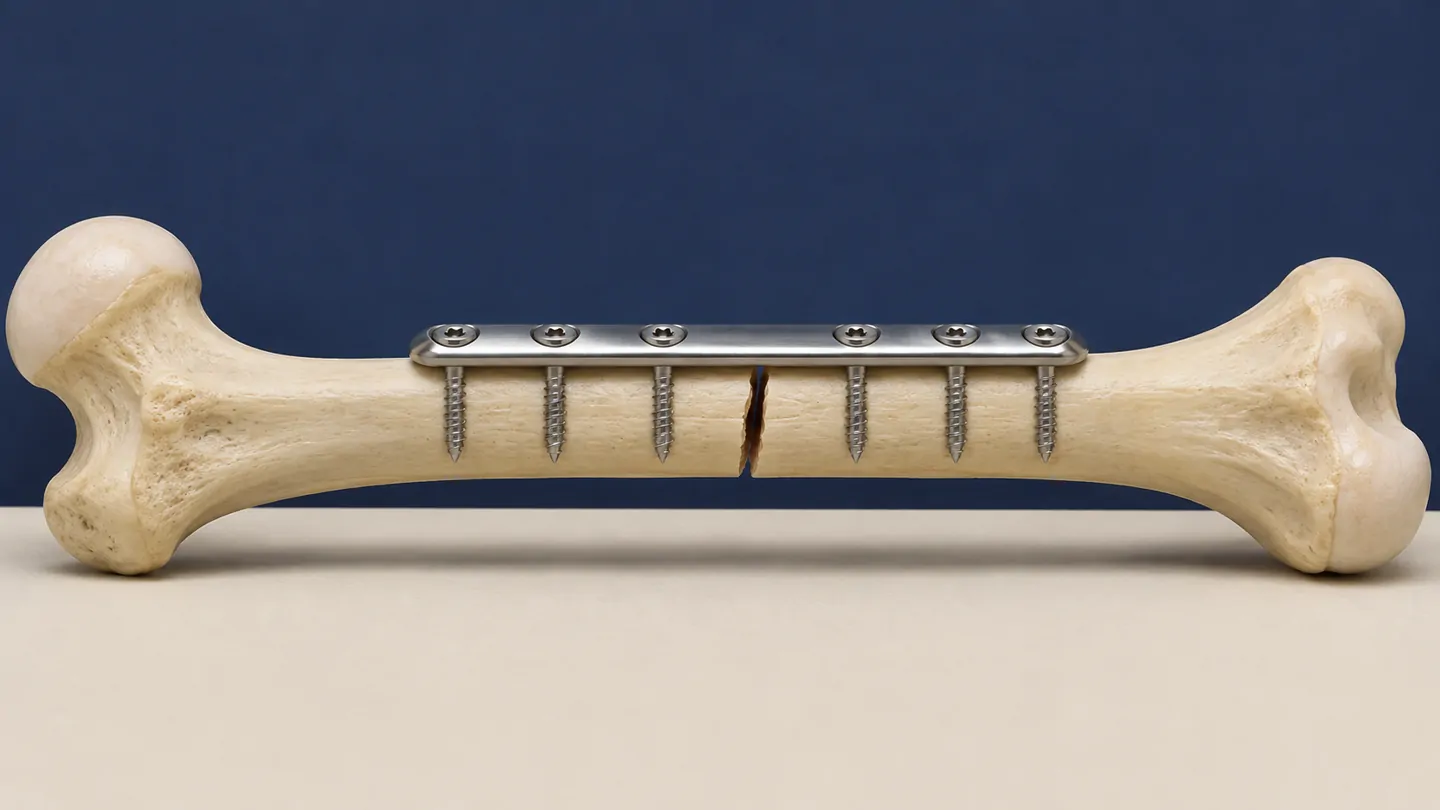
Why can a fracture remain unhealed despite a plate?
A plate or intramedullary nail provides fixation, but healing also requires the bone ends and surrounding tissues to support new bone formation. Public patient information from Zhongnan Hospital of Wuhan University identifies restoration of stability, improved blood supply and restored bone biological activity as treatment priorities. Having had fixation does not mean these conditions have remained adequate. Zhongnan Hospital: nonunion treatment
If the fracture ends remain unstable, revision may require changes to fixation. If there is dead bone, scar tissue or a bone defect, stronger fixation alone may be insufficient. Bone grafting supports new bone growth and addresses a different problem from fixation; some patients need both. Zhongnan Hospital also discusses cleaning the fracture ends, grafting and reconstruction of bone defects. No single technique is mandatory for everyone. Zhongnan Hospital: nonunion treatment
Severe trauma can also damage the blood supply to bone and surrounding soft tissues. Reassessment therefore covers both the bone and the original wound and soft-tissue condition. Even when both cases are called nonunion, the scope of further treatment may differ substantially. WashU orthopedic patient information
Continued fixation or revision assessment?
The two pathways differ in the problem they need to address. Incision size or material names cannot determine the choice. AAOS explains that some nonunions can be treated without surgery using a cast or brace. Surgery may be needed if nonsurgical treatment fails, and may involve bone grafting and internal or external fixation. AAOS: nonunions
| Comparison | Continued nonsurgical fixation and follow-up | Revision surgery assessment |
|---|---|---|
| Question for the doctor | Is nonsurgical care still suitable, and is healing progressing? | Why has healing not occurred, and which local problems need treatment? |
| Possible measures | Cast or brace fixation and subsequent imaging | Adjust fixation; consider grafting and other measures according to bone defects and biological activity |
| Main limitations | Cannot replace necessary debridement or reconstruction | Invasive treatment; extent depends on infection, soft tissues and previous fixation |
| Follow-up focus | Changes in pain and bone bridging on serial images | Bone healing, fixation and control of infection |
The pathways in the table draw on AAOS, Zhongnan Hospital and the infection guideline discussed below. They are a framework for discussion, not criteria for patients to assign themselves to treatment. If another operation is proposed, ask whether its main purpose is to address fixation, bone loss or infection, and whether staged treatment is expected. These questions clarify the rationale more than simply asking which plate will replace the old one.
Why investigate infection separately?
Infection can impede fracture healing and change plans for fixation and reconstruction. Blood counts and C-reactive protein (CRP) support assessment, but normal results alone cannot rule out fracture-related infection. The 2025 guideline from COSECSA and other organizations also calls for history, examination and serial images to assess healing, implant loosening and bone loss. Fracture-related infection guideline, sections 2–4
If infection is suspected, the doctor may need deep tissue samples taken during surgery for microbiological and histological examination. A surface wound swab cannot replace this sampling. The guideline recommends joint assessment with appropriate specialist support for complex infected nonunions and major bone or soft-tissue defects. Fracture-related infection guideline, sections 2–4
At consultation, explain any recurrent wound drainage, previous debridement, and the names and use history of antibiotics. Do not stop medicines yourself to prepare for sampling. Seek prompt local care for marked systemic illness or other signs suggesting severe infection; do not wait for an elective cross-border assessment. The guideline explicitly requires immediate assessment and urgent treatment for signs of systemic sepsis. Fracture-related infection guideline, sections 2–4
When seeking another opinion from an orthopedic doctor in China, submit medical records, images, operation records and medication history in date order. Jia Zhang’s published profile lists nonunion and malunion among his areas of practice and can support matching for a consultation. The hospital still confirms acceptance and the individual treatment plan. Jia Zhang’s published profile
Frequently asked questions
If a fracture is not healing, is more calcium always better?
No. Balanced nutrition supports healing, but supplements beyond daily needs cannot replace treatment of the cause. A doctor should assess any nutritional deficiency. AAOS: nonunions
Does an infected nonunion always require removal of all internal fixation?
No. The guideline allows retention to be considered when fixation is stable and reduction satisfactory, among other conditions. Inadequate fixation may need replacement, based on the team’s assessment. Fracture-related infection guideline, sections 2–4
Need help?
Tell us about your situation and needs. Incomplete records are welcome.