
Visit preparation
Can the pulp be preserved when decay is close to the tooth nerve?
Deep decay may still allow pulp preservation if viable pulp can be retained, infection controlled and the tooth reliably restored and sealed.
Assess the pulp and the remaining tooth first
Deep decay on an X-ray does not automatically mean the tooth needs its nerve removed. Vital pulp therapy aims to retain functioning pulp tissue. Besides providing sensation, the pulp contributes to dentine formation, defence and repair. For adult permanent teeth, assessment also considers the extent of infection and whether the tooth can be restored.[1]
Tell the dentist about spontaneous pain, responses after hot or cold stimuli, and previous fillings or injuries. These offer diagnostic clues, but patients cannot determine whether the pulp is alive from pain severity alone. Cold testing and the commonly named “electric pulp vitality test” mainly assess nerve sensation; they do not directly measure blood supply. No response also needs interpretation alongside other examinations.[1]
Periapical and bitewing X-rays help show decay depth, its relationship to the pulp chamber and bone changes around the root tip. They cannot reveal the full extent of pulp inflammation. An X-ray without an obvious shadow around the root tip does not, by itself, prove healthy pulp. Ask the dentist to explain the images together with sensibility tests and the examination inside the mouth.[1]
Another easily overlooked question is whether the retained tooth can be adequately restored and sealed. If the remaining tooth structure cannot be restored, asking only about saving the nerve misses a condition central to saving the tooth. A 2026 expert commentary by authors from West China Hospital of Stomatology identifies restorability and the coronal seal as core preoperative considerations.[1]
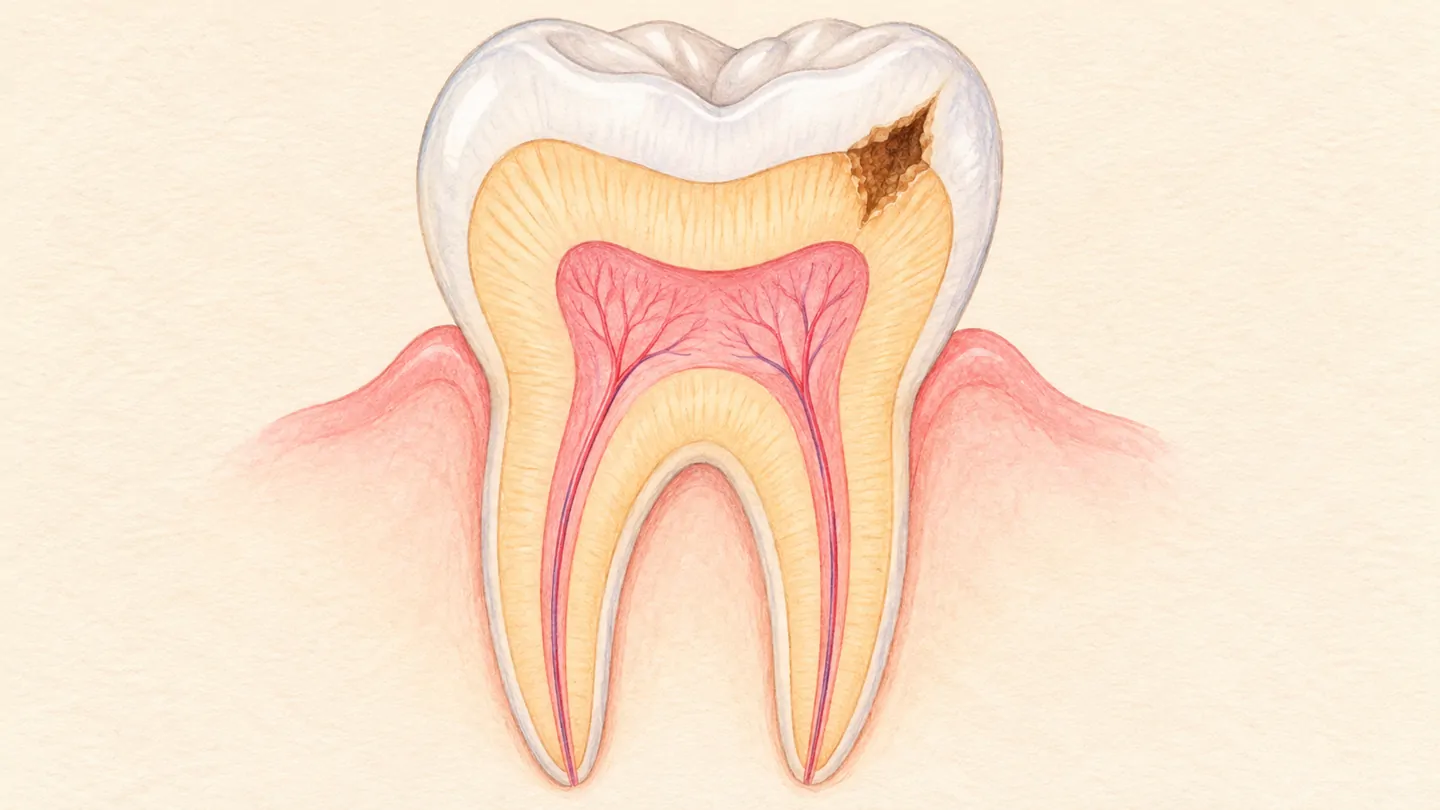
What do pulp therapy and root canal treatment preserve?
Saving a tooth and saving its pulp are different goals. Root canal treatment also aims to retain the tooth, but does not retain pulp in its root canals. Vital pulp therapy includes indirect pulp capping, direct pulp capping, and partial or complete removal of the coronal pulp. Removing coronal pulp can still preserve living pulp in the roots: “pulpotomy” does not necessarily mean removing all pulp.[1]
| Comparison | Vital pulp therapy | Root canal treatment |
|---|---|---|
| Tissue retained | All or part of the living pulp, depending on the condition | Pulp tissue is removed from the root canal system |
| Main treatment | Control infection, cap the pulp or remove part of the coronal pulp as appropriate, then seal | Clean, disinfect and fill the root canals, followed by restoration |
| Key decision | Whether viable pulp can be retained, infection controlled and a reliable seal achieved | Pulp and periapical diagnoses, together with suitability for pulp preservation |
| Follow-up concerns | Remaining pulp and the restoration seal | Tissues around the root tip and the restoration seal |
The table compares goals and conditions; it cannot be used to select a procedure remotely. Vital pulp therapy is unsuitable for some deep cavities. Confirmed pulp necrosis, an abscess or sinus tract, or an unrestorable tooth require the dentist to reassess the treatment pathway.[1]
After removing decay, the dentist may reassess the exposed pulp surface. Before treatment, ask what findings would change a planned pulp-preserving approach and what further informed discussion would be needed. This is more useful than seeking a guarantee that the nerve can be saved before the tooth has been examined.
What should you ask during assessment in China?
A department of endodontics and restorative dentistry at a dental hospital or general hospital can explain assessment options. An August 2025 explanation of adult vital pulp therapy from the relevant department at the Affiliated Hospital of Shandong Medical University describes situations including accidental pulp exposure during treatment of deep decay in adult permanent teeth. It also describes microscopic observation, bleeding control and immediate sealing. Adult pulp preservation therefore has specific clinical requirements; it is not a topic limited to children's teeth.[2]
This single hospital's information is not a nationwide standard and does not establish current appointment availability, acceptance of international patients or individual outcomes. Patients should not use the numerical indications in that explanation to decide their own eligibility.
When comparing plans, ask the treating dentist to specify which part of the pulp would be retained, when restoration would be completed and how outcomes would be assessed. Arrange previous dental X-rays and filling records chronologically, and mention crowns or extensive restorations to help the dentist explain the findings.[1,2]
Before returning home, obtain the names of completed treatments, restorative materials and follow-up arrangements. The literature on vital pulp therapy includes follow-up assessment, and the hospital's procedural explanation emphasises sealing. Absence of pain is not the sole criterion for success. The treating dentist determines follow-up timing and examinations; a fixed number of days in China should not dictate the treatment course.[1,2]
If further assessment indicates root canal treatment, read How microscopy helps with calcified or missed root canals. That article explains how a tool assists treatment, a different question from choosing pulp preservation for initial deep decay.
Common questions
Is a microscope always needed for adult vital pulp therapy?
Equipment alone cannot decide the approach. This hospital describes microscopic observation; suitability also depends on infection, remaining pulp and sealing conditions.[1,2]
Must I choose a particular material brand for deep decay?
A brand alone cannot determine treatment. The hospital's explanation also covers diagnosis, bleeding control and sealing; a material name cannot replace these clinical requirements.[2]
Does this approach apply to a tooth that has already had root canal treatment?
This article concerns teeth that may still contain viable pulp worth preserving. Pain after completed root canal treatment calls for assessment of retreatment or other pathways; see Assessing tooth preservation when pain returns after root canal treatment.[1]
Need help?
Tell us about your situation and needs. Incomplete records are welcome.
Related reading
Sources and references
- Zhang Luyue et al.: Advances in materials and techniques for vital pulp therapy in mature permanent teeth with pulpitis, Chinese Journal of Stomatological Research (Electronic Edition), 2026-06-25. Used for diagnosis, preoperative assessment and treatment definitions. This is expert commentary, not a treatment promise applicable to every patient.
- Department of endodontics and restorative dentistry, Affiliated Hospital of Shandong Medical University: Adult vital pulp therapy, 2025-08-01. A single hospital's technical explanation, not comparative evidence of effectiveness.